50/20, 55/15 and 65/20 Naturalization Test Exceptions Explained

Last verified: July 27, 2026. The 50/20, 55/15 and 65/20 rules are naturalization test exceptions and can exempt certain long-term Green Card holders from the English portion of the naturalization test. They do not automatically waive the civics test. The applicant’s age and years as a lawful permanent resident are measured on the date USCIS receives Form N-400.
50/20, 55/15 and 65/20 Naturalization Test Exemptions
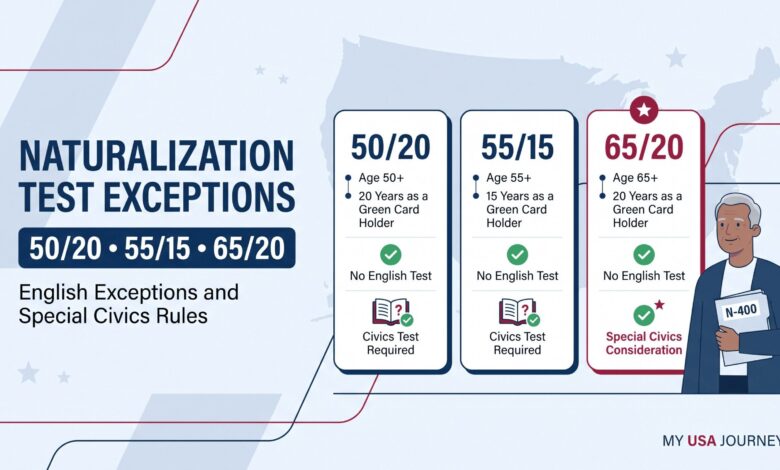
These rules are often described too loosely as citizenship test exemptions or naturalization test exemptions. In reality, 50/20 and 55/15 are English-language exceptions. The 65/20 rule combines the English exception with special consideration on the civics test. This guide explains exactly what each applicant must still do, which test version applies, and how to prepare an interpreter.
50/20, 55/15 and 65/20 rules at a glance
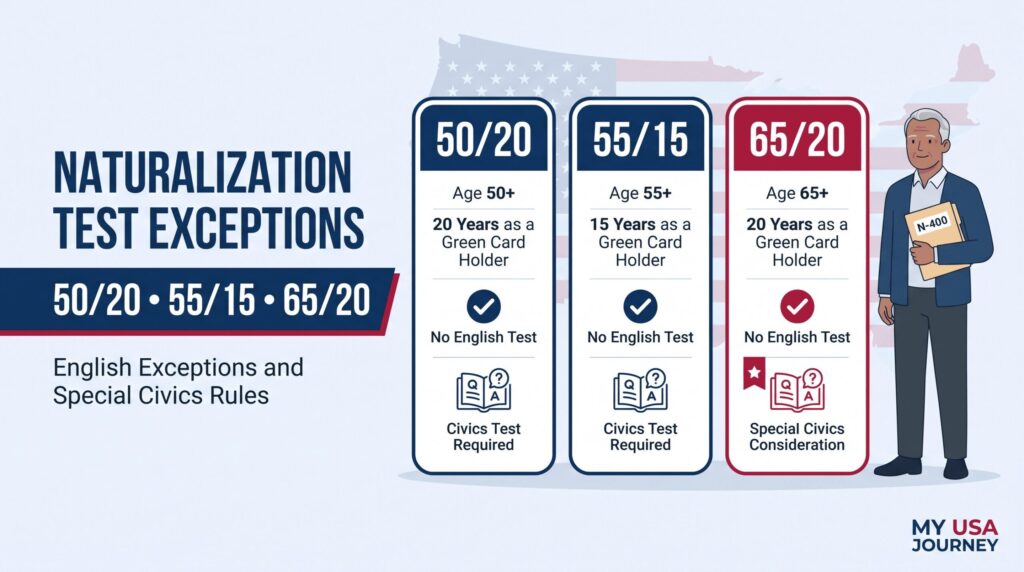
| Rule | Age on N-400 filing date | Time as permanent resident | English test | Civics test |
|---|---|---|---|---|
| 50/20 | At least 50 | At least 20 years | Exempt | Required; may use chosen language |
| 55/15 | At least 55 | At least 15 years | Exempt | Required; may use chosen language |
| 65/20 | At least 65 | At least 20 years | Exempt | Required with special study list and format |
An applicant who meets one of these rules may take the civics test in the language of their choice. If that language is not English, the applicant must bring a qualified interpreter to the interview. USCIS does not treat age alone, or a long period living in the United States without permanent resident status, as sufficient.
What is the 50/20 naturalization test exception?
The 50/20 exception applies when the applicant is at least 50 years old and has lived in the United States as a lawful permanent resident for at least 20 years at the time of filing Form N-400. The applicant does not have to demonstrate the ordinary English speaking, reading and writing requirements.
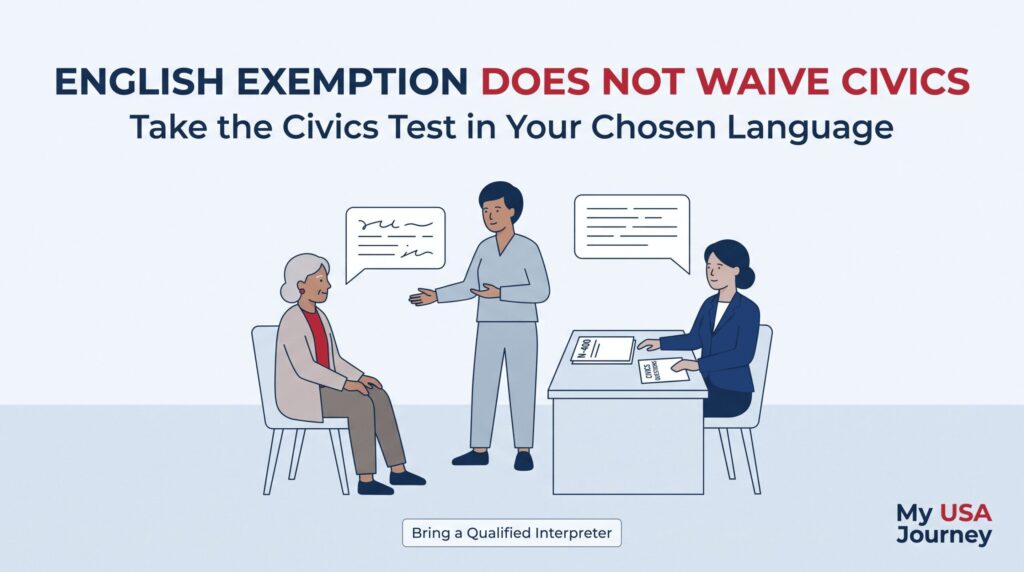
The civics requirement remains. The officer may administer it in the applicant’s chosen language through an interpreter. Unless the applicant also qualifies for 65/20, the ordinary civics question pool and passing rules for the applicable test version still apply.
What is the 55/15 naturalization test exception?
The 55/15 exception applies when the applicant is at least 55 years old and has held lawful permanent resident status for at least 15 years on the N-400 filing date. Like 50/20, it removes the English testing requirement but does not remove the civics requirement.
A 56-year-old applicant with 16 years as a permanent resident may therefore take civics in a preferred language. A 54-year-old applicant with 20 years as a resident does not yet meet 55/15, but may meet 50/20 because the applicant is over 50 and has at least 20 qualifying years.
What special consideration does 65/20 provide?
The 65/20 rule applies to an applicant who is at least 65 years old and has been a lawful permanent resident for at least 20 years when filing. It includes the English exception and allows the civics test in the applicant’s chosen language. It also limits preparation to a specially designated list of 20 civics questions.
The interview format depends on which civics test applies. USCIS uses the Form N-400 filing date, not the interview date, to select the test. Applicants who filed before October 20, 2025 generally take the 2008 civics test. Applicants who filed on or after that date generally take the 2025 civics test.
65/20 under the 2025 civics test
For a qualifying 65/20 applicant under the 2025 test, the officer asks up to 10 questions from the designated 20-question list. The applicant passes after 6 correct answers. The officer stops after 6 correct answers or 5 incorrect answers.
65/20 under the 2008 civics test
For a qualifying applicant under the 2008 test, USCIS also uses the specially designated 20-question list. The officer asks up to 10 questions, and 6 correct answers are required. Applicants should study the official materials matching their filing date rather than mixing question sets.
How USCIS counts age and permanent-resident years
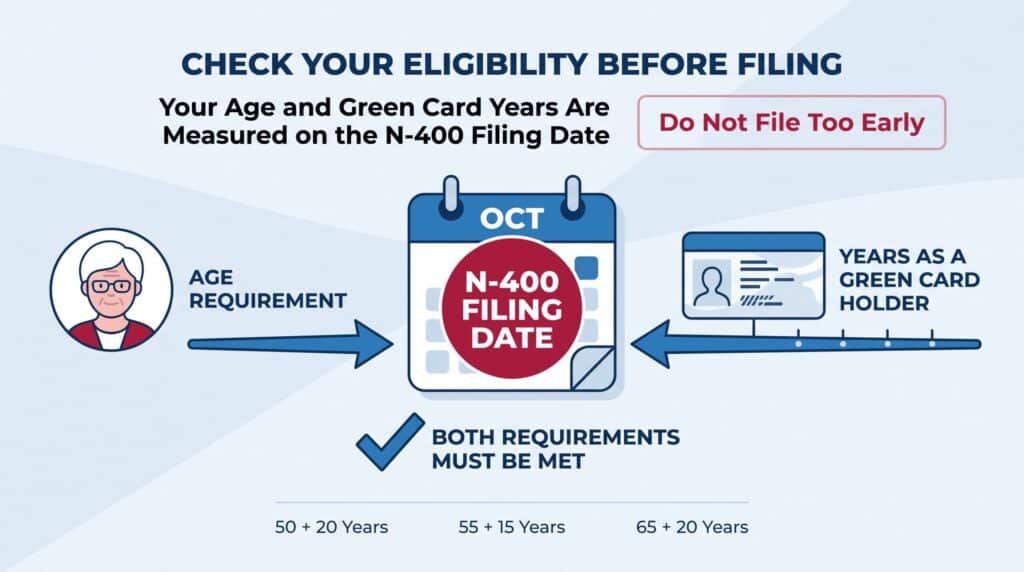
Both requirements must be satisfied when Form N-400 is filed. A birthday or residence anniversary occurring after filing does not retroactively create eligibility for the exception. Waiting until the required date can be safer than filing early and asking the officer to apply a rule that was not met on receipt.
- Count age from the applicant’s date of birth to the N-400 filing date.
- Count permanent residence from the “Resident Since” date shown on the Green Card, subject to any unusual status history.
- Do not count years spent in the United States only as a visitor, student, worker, parolee or asylum applicant.
- Do not assume the general 90-day early-filing rule lets an applicant satisfy an English exception early.
- Keep copies of current and expired Green Cards or other USCIS records if the residence history is unclear.
The 90-day early-filing provision concerns the continuous-residence period for certain naturalization applicants. It does not rewrite the statutory age and permanent-resident-duration conditions for 50/20, 55/15 or 65/20.
Do long trips abroad erase the years needed for these exceptions?
USCIS policy allows the qualifying residence periods for these English exceptions to include time spent outside the United States. The years as a lawful permanent resident do not have to be immediately before filing. However, this does not excuse the separate naturalization requirements for continuous residence, physical presence and residence in the state or USCIS district.
For example, a person may have held a Green Card for 20 years and meet the duration element of 50/20, yet still face a naturalization eligibility issue after a long absence. Applicants with trips of six months or more should review the separate rules in our continuous residence and physical presence guide.
Which parts of the English test are waived?
A qualifying applicant is exempt from the English-language requirement, including the ordinary assessment of speaking during the N-400 review and the English reading and writing tests. USCIS can conduct the relevant examination through the chosen language and interpreter.
The exception does not eliminate the need to understand the questions, testify under oath, review the application, correct errors and demonstrate eligibility. The interpreter facilitates communication; the interpreter does not answer for the applicant or coach the applicant during civics testing.
The civics test is still mandatory
Applicants under 50/20 and 55/15 generally take the same civics test version as other applicants, but in their chosen language. For N-400 filings on or after October 20, 2025, the ordinary 2025 test draws from 128 questions, asks up to 20 and requires 12 correct answers. The officer stops after 12 correct or 9 incorrect answers.
Only qualifying 65/20 applicants receive the special 20-question study list and the 6-of-10 passing format. Our 2025 U.S. Civics Test guide explains the filing-date rule and stop rules in more detail.
How to arrange an interpreter for the interview
USCIS instructs applicants using an age-and-residence English exception to bring an interpreter when taking the civics test in another language. The applicant should not assume the field office will provide one. The interpreter must be sufficiently fluent in both English and the chosen language to translate accurately.
- Choose a reliable adult who can translate the N-400 review, civics questions and answers accurately.
- Bring the interpreter’s valid government-issued identification.
- Avoid a person whose personal interest in the case could affect impartial translation.
- Review names, addresses, travel dates, legal terms and N-400 vocabulary in advance.
- Follow the officer’s instructions and allow the interpreter to translate everything rather than summarizing.
USCIS may reject an interpreter who is not competent or impartial. An applicant relying on a family member should be prepared for the officer to assess whether that person can translate faithfully. An attorney or accredited representative may attend, but representation and interpretation are separate functions.
How to claim the exception on Form N-400
The current Form N-400 asks questions that identify possible English and civics exceptions. Complete the relevant section accurately and provide the applicant’s date of birth and permanent-resident history consistently throughout the form. No separate application is normally required solely to claim 50/20, 55/15 or 65/20.
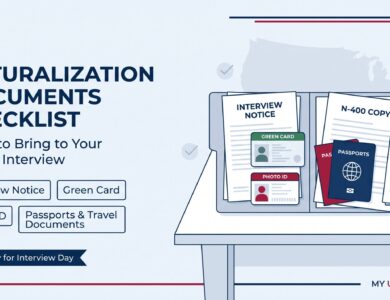
Bring the interview notice, Green Card, identity document and travel documents, along with any records needed to clarify the residence date. Our naturalization interview documents checklist separates documents required for everyone from situation-specific evidence.
Age exceptions are different from Form N-648
Form N-648 is a medical certification for a disability exception. It may be appropriate when a physical or developmental disability or mental impairment prevents the applicant from meeting English, civics or both requirements. Age, low education, illiteracy or difficulty learning English by themselves do not establish N-648 eligibility.
| Path | Basis | What may be waived | Main document |
|---|---|---|---|
| 50/20 or 55/15 | Age plus years as permanent resident | English only | N-400 eligibility responses |
| 65/20 | Age plus 20 resident years | English; special civics consideration | N-400 eligibility responses |
| N-648 | Qualifying medically determinable impairment | English, civics or both as medically supported | Form N-648 completed by authorized medical professional |
A person may qualify under both an age exception and a medical exception, but the legal bases should not be confused. Form N-648 has detailed medical requirements and should be completed according to current USCIS instructions.
Common mistakes that can delay the case
- Treating 50/20 or 55/15 as a complete waiver of the civics test.
- Using the applicant’s arrival date instead of the permanent-resident date.
- Filing shortly before the required birthday or residence anniversary.
- Studying only the 65/20 questions without actually meeting both 65 and 20 requirements.
- Preparing for the wrong civics test version based on the interview date instead of the N-400 filing date.
- Arriving without a competent interpreter after choosing a non-English examination.
- Using Form N-648 only because learning English or civics is difficult.
- Ignoring separate continuous-residence or physical-presence problems.
How to prepare for a non-English naturalization interview
An English exception changes the language of the examination, not the standard of truthfulness or the underlying naturalization requirements. Before the appointment, the applicant should review a complete copy of the filed N-400 in the chosen language. Dates and facts should remain consistent with the English form in USCIS records. If an answer has changed since filing, the applicant should be ready to explain the update through the interpreter.
Preparation should cover more than civics flash cards. The officer may review addresses, employment, trips outside the United States, marital history, children, taxes, Selective Service, organizations, arrests and the yes-or-no eligibility questions. The applicant must personally provide the answers. An interpreter may translate a legal term or repeat the applicant’s response accurately, but cannot replace the applicant’s knowledge of the case.
- Prepare a simple timeline of addresses, jobs and international travel that matches the N-400.
- Practice hearing each civics question in the exact language that will be used at the interview.
- Verify answers involving current officials shortly before the appointment because some answers change after elections or appointments.
- Tell the officer immediately if a question or translation is not understood rather than guessing.
- Bring original or certified records for any issue identified in the application and use complete certified translations where required.
What happens if the applicant fails the civics test?
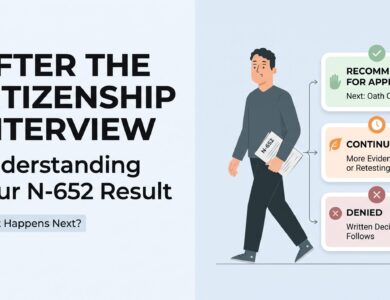
Qualifying for 50/20, 55/15 or 65/20 does not change the general opportunity to be tested a second time after an initial failure. USCIS normally schedules a reexamination between 60 and 90 days after the first examination and retests only the portion that was failed. The written decision or interview results notice should identify what remains to be completed.
A 65/20 applicant keeps the special consideration at the reexamination because eligibility was established for the application. The applicant should continue studying the official designated questions for the correct test version. A 50/20 or 55/15 applicant who failed civics should prepare from the ordinary question set applicable to the N-400 filing date, while continuing to use the approved language and a qualified interpreter.
When legal advice may be useful
Many age-exception cases are straightforward, but the testing rule does not protect an applicant from problems elsewhere in the file. Individual legal advice may be important when the permanent-resident date is disputed, status was obtained through facts USCIS may reexamine, travel may have broken continuous residence, taxes were filed inconsistently, criminal records exist, or prior N-400 answers conflict with the current application.
An attorney cannot promise approval and does not take the civics test for the applicant. Counsel can help identify whether filing now is safe, organize records, address corrections and attend the interview. Applicants should use a licensed immigration attorney or a Department of Justice-accredited representative and avoid unlicensed immigration consultants offering guaranteed results.
Examples
Example 1: qualifies under 50/20
Maria is 52 and has held a Green Card for 21 years. She qualifies for the English exception and may take the ordinary civics test in Spanish with an interpreter. She does not receive the special 65/20 question list because she is not 65.
Example 2: qualifies under 55/15
Ahmed is 58 and has been a permanent resident for 16 years. He qualifies under 55/15 even though he does not have 20 resident years. He remains subject to the ordinary civics test for his filing date.
Example 3: must wait for 65/20
Linh is 64 years and 11 months old and has held a Green Card for 24 years. Filing today may qualify her for 50/20, but not 65/20. If she wants the special civics consideration, she should not assume a birthday after filing will cure the issue.
Example 4: duration met but travel issue remains
Robert is 67 and has held permanent residence for 22 years, so he meets 65/20. A recent absence lasting more than one year may nevertheless have disrupted continuous residence. The test exception does not decide that separate eligibility issue.
Frequently asked questions : Naturalization test exceptions
Does 50/20 waive the entire citizenship test?
No. It waives the English requirement, but the applicant must still pass the applicable civics test.
What does 55/15 mean for naturalization?
It means an applicant who is at least 55 and has been a permanent resident for at least 15 years may be exempt from English testing and take civics in a chosen language.
What is special about the 65/20 rule?
It provides the English exception and special civics consideration, including a designated 20-question study list and a 6-of-10 format.
Can I count years before receiving my Green Card?
No. The duration requirement is based on time as a lawful permanent resident, not all years physically present in the United States.
Can I file before my birthday or Green Card anniversary?
The age and permanent-resident duration must be met on the N-400 filing date. The general 90-day early-filing rule does not make these exceptions available early.
Do I need an interpreter?
Bring a qualified interpreter if you will take the examination in a language other than English. Do not assume USCIS will supply one.
Can my child interpret at the naturalization interview?
USCIS must be satisfied that the interpreter is competent and impartial. A reliable adult is generally safer than relying on a minor.
Do 50/20 applicants study only 20 civics questions?
No. The special 20-question list is for applicants who meet 65/20, not everyone who qualifies for an English exception.
Which civics test applies if my interview is in 2026?
The N-400 filing date controls. Filings on or after October 20, 2025 generally use the 2025 test; earlier filings generally use the 2008 test.
Can long travel affect my exception?
Time abroad may still count toward the years of permanent residence for the English exception, but travel can separately affect continuous residence and physical presence.
Is illiteracy enough for Form N-648?
No. N-648 requires a qualifying medically determinable disability or impairment that prevents compliance with English, civics or both requirements.
Do I need a separate form for 50/20, 55/15 or 65/20?
Normally no separate form is required solely for these age-and-residence exceptions. Complete the relevant N-400 questions accurately and bring supporting identity and residence records.
Official USCIS sources
- USCIS: Exceptions and Accommodations
- USCIS Policy Manual: English and Civics Testing
- USCIS: 2025 Civics Test
- USCIS: Form N-400
- USCIS: Form N-648