
U.S. Citizenship Through Naturalization: Form N-400 Guide for 2026


Last verified: September 5, 2026. Form N-400 is the application most lawful permanent residents use to request U.S. citizenship through naturalization, but the right filing date depends on more than the date printed on your Green Card. Before you submit, you should know which eligibility route applies, whether your travel still satisfies the residence rules, whether any history needs closer review, which naturalization test applies, and the fee and form edition USCIS accepts today.
Start with the decision: if your eligibility basis, residence calculations, filing date, and background are straightforward, you may be ready to prepare Form N-400. If one of those areas is uncertain, the useful next step is usually to resolve that issue before you file—not to rush through the form and hope the interview fixes it.
This page is the navigation guide for the MyUSAJourney Citizenship & Naturalization cluster. It gives you the complete filing-to-oath path and tells you where a deeper check is worth doing. It does not replace individualized legal advice.
N-400 Naturalization Readiness Check
Use this table before you start typing answers into Form N-400. It is not a legal eligibility calculator; it is a way to identify the parts of your case that deserve verification.
| Check before filing | Typical rule to verify | Why it matters | Read next |
|---|---|---|---|
| Eligibility basis | Most applicants use the 5-year LPR route; some qualify under the 3-year spouse route or special provisions | Your route changes the statutory period and some evidence | See the route comparison below |
| Green Card time requirement | Usually 5 years, or 3 years for a qualifying spouse-of-U.S.-citizen case | Marriage to a U.S. citizen does not automatically create 3-year eligibility | Check the 90-day rule before choosing a filing date |
| Continuous residence | You must maintain the required U.S. residence period | Long absences can disrupt the residence period even when you kept a Green Card | Continuous residence vs. physical presence |
| Physical presence | General 5-year route: at least 30 months; qualifying 3-year route: at least 18 months | This is a day-count requirement separate from continuous residence | Recalculate after recent travel |
| State / USCIS district residence | Generally at least 3 months before filing | The 90-day early-filing rule does not erase this separate requirement | Verify your filing jurisdiction before submitting |
| Good moral character and background | USCIS reviews the statutory period and can consider relevant conduct | Criminal, tax, support, misrepresentation, voting, Selective Service or other history may need closer review | Do not rely on a generic online checklist for a risk issue |
| English and civics | Most 2026 filers take the 2025 civics test plus English unless an exception applies | Studying the wrong version wastes preparation time | 2025 civics test rules |
| Correct filing timing | Certain 5-year and 3-year applicants may file up to 90 calendar days early | Filing too early can lead to denial | Use the USCIS early-filing guidance |
| Current fee and form edition | Use the fee and accepted form edition in effect on the filing date | Fees are currently unchanged, but DHS proposed a major increase in June 2026 | N-400 fees guide |
| Documents and unresolved issues | Core evidence plus records triggered by your route and history | The same document list does not fit every applicant | Naturalization documents checklist |
Before N-400: could you already be a U.S. citizen?
Form N-400 is an application to naturalize. It is not the correct path for every person who needs proof of citizenship. Some people may already have acquired or derived U.S. citizenship through a parent. If that possibility applies to you, verify your citizenship status before filing N-400; a passport or Form N-600 path may be the relevant question instead.
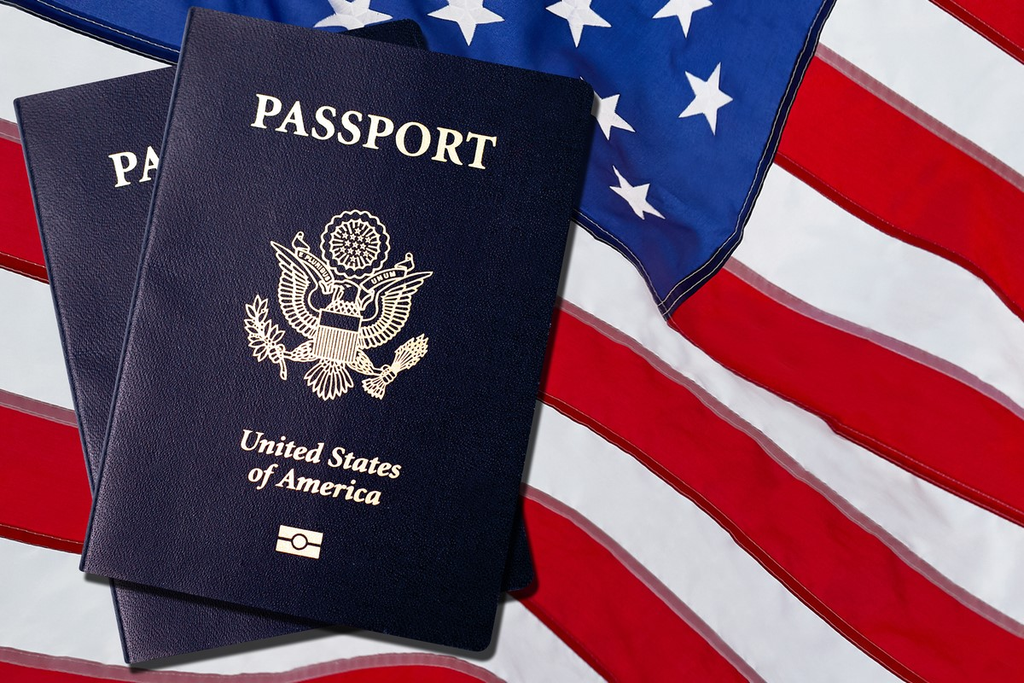
For most adult Green Card holders who are not already citizens through another rule, the next question is which naturalization route applies.
Which naturalization route applies to you?
| Eligibility basis | Typical LPR period | Important additional condition |
|---|---|---|
| General lawful permanent resident route | 5 years | Continuous residence, at least 30 months of physical presence, state/district residence, good moral character and other naturalization requirements |
| Qualifying spouse of a U.S. citizen | 3 years | Additional U.S.-citizen-spouse and marital-union requirements apply; marriage alone is not enough |
| Military or other special statutory route | Varies | Use the USCIS rule for the specific provision rather than forcing the case into the 5-year or 3-year model |
The 3-year route is frequently oversimplified. Being married to a U.S. citizen does not automatically mean you may file after three years. USCIS looks at the qualifying spouse’s citizenship and the marital-union requirements in addition to the applicant’s permanent-resident period, residence, physical presence, and the other naturalization requirements.
Can you file N-400 90 days early?
USCIS permits applicants whose eligibility is based on the 5-year or qualifying 3-year continuous-residence provisions to file Form N-400 up to 90 calendar days before completing that continuous-residence requirement. This is not simply “three months early,” and it does not move every other requirement forward.
Practical meaning: calculate the 90-day window with the official USCIS N-400 Early Filing Calculator, then separately confirm that the requirements that must already be satisfied at filing—such as the applicable state or USCIS district residence requirement—are met. Do not pick a date by subtracting three calendar months from your anniversary.
Should you file N-400 now — or check something first?
| Your situation | What to check before filing | Why |
|---|---|---|
| You had a long trip outside the United States | Review continuous residence and reconstruct exact travel dates | A long absence can affect continuous residence differently from physical presence |
| You are using the 3-year spouse route | Verify every marriage, citizenship and marital-union condition | A Green Card obtained through marriage does not by itself establish 3-year naturalization eligibility |
| You recently traveled internationally | Recalculate physical presence through the filing date | Your day count can change after a new trip |
| You are close to your eligibility anniversary | Check the 90-calendar-day early-filing rule | Filing one day too early can create an avoidable problem |
| You did not file a required tax return or owe taxes | Clarify the filing/payment situation and gather relevant records | Tax compliance can be relevant to good moral character; tax debt is not an automatic identical outcome in every case |
| You have an arrest, citation, conviction or other criminal history | Obtain records and understand the immigration significance before filing | Dismissal, expungement or age of the incident does not automatically make it irrelevant to N-400 |
| You may have a Selective Service issue | Verify whether an obligation applied and document the history | The analysis can depend on age, status, presence in the United States and the reason for non-registration |
| Your records contain different names, dates or other material facts | Resolve the discrepancy or prepare accurate supporting evidence | N-400 and the interview require truthful, internally consistent information |
| You are unsure which test to study | Use the N-400 filing date—not the interview date | Applications filed in 2026 use the 2025 civics test under the current transition rule |
N-400 fees in September 2026: current rule vs. proposed change
The fee discussion changed in 2026, but the current USCIS fee has not yet changed. As of September 5, 2026, USCIS still lists the standard N-400 fee as $710 online or $760 on paper. A qualifying reduced-fee paper filing is $380, and certain applicants may still request a fee waiver. Qualifying military naturalization filings under INA sections 328 or 329 remain fee-exempt.
| Filing option | Current fee — Sep. 5, 2026 | June 2026 DHS proposal |
|---|---|---|
| Standard online N-400 | $710 | $1,280 proposed |
| Standard paper N-400 | $760 | $1,330 proposed |
| Reduced-fee N-400 | $380, qualifying paper filing | Proposed to be eliminated |
| Ordinary N-400 fee waiver | May be available to qualifying applicants | Proposed to be eliminated |
| Qualifying military filing under INA 328/329 | $0 | Proposed to remain fee-exempt |
Current rule: pay the fee required by the USCIS Fee Schedule in effect when you file.
Proposed change: DHS published a notice of proposed rulemaking in June 2026 that would increase N-400 fees and eliminate the ordinary reduced-fee and fee-waiver options for this form.
What to do today: do not pay a proposed future amount. Check the official USCIS Fee Schedule immediately before filing. A proposal becomes operational only after the required rulemaking process and an applicable effective date.
The June proposal is important enough to monitor, but it should not be presented as current law. For income rules, fee-waiver mechanics, payment methods and a deeper fee breakdown, use our N-400 fees, reduced fees and fee waivers guide.
Verify the Form N-400 edition before you mail it
The official Form N-400 PDF checked on September 5, 2026 displays Edition 01/20/25. That is a useful verification point, not permission to save an old copy forever. USCIS can update forms and acceptance rules.
Before mailing a paper application, open the official USCIS Form N-400 page, confirm the accepted edition and instructions, and make sure all pages come from the same accepted edition. Also recheck the filing address and payment method at that time.
Continuous residence and physical presence are two different checks
Continuous residence asks whether you maintained the required residence in the United States over the statutory period. Physical presence is a separate count of how much time you were actually inside the United States.
For the general 5-year route, the usual physical-presence requirement is at least 30 months during the relevant five years. For a qualifying 3-year spouse route, it is at least 18 months during the relevant three years. Meeting the day count does not automatically prove continuous residence, and maintaining continuous residence does not automatically prove you have enough physical-presence days.
Simple example: an applicant might still have well over 30 months of total physical presence but have one unusually long absence that creates a separate continuous-residence issue. The two calculations must be checked independently.
Travel rules are more nuanced than “never leave for six months.” The duration of an absence matters, but so can the surrounding facts and any specific preservation rule that applies. If you have significant travel history, stop and calculate before filing. Our continuous residence vs. physical presence guide explains the distinction and travel scenarios in detail.
Good moral character: identify risk issues, not a fake safe-list
Good moral character is a legal naturalization requirement, not a short checklist where the absence of five red flags guarantees approval. Form N-400 asks broad questions, and USCIS evaluates the required statutory period while certain conduct outside that period can also matter in the analysis.
Issues that deserve closer review can include criminal history, arrests or citations where relevant, false statements or false claims, unlawful voting issues, tax compliance, failure to support dependents, Selective Service history, probation or parole, and other conduct covered by the form and naturalization law. This list is deliberately not exhaustive.
Taxes
USCIS instructions specifically address tax filing and overdue taxes. Unpaid taxes do not produce one automatic outcome in every case, but a failure to file required returns or unresolved tax problems can be relevant. Depending on the facts, tax transcripts, proof of filing, a payment agreement and evidence that payments are current can become important.
This is an immigration readiness point, not tax advice. If your tax filings and immigration history do not line up, understand the discrepancy before making sworn statements in an N-400 case.
Selective Service
If your history raises a Selective Service registration question, avoid an automatic “eligible/not eligible” conclusion from a generic checklist. Whether an obligation applied can depend on the applicant’s age during the relevant period, immigration status, presence in the United States and the reason registration did not occur. Gather the record and verify the rule that actually applied to your history.
Which citizenship test applies if you file in 2026?
The N-400 filing date controls the civics-test version under the current transition rule. Current federal guidance states that applicants whose N-400 was filed before October 20, 2025 take the 2008 civics test, while applicants whose N-400 was filed on or after October 20, 2025 take the 2025 civics test. Therefore, a new N-400 filed in 2026 uses the 2025 test.
| N-400 filing date | Civics version | Format |
|---|---|---|
| Before October 20, 2025 | 2008 civics test | 100-question study bank; officer asks up to 10; 6 correct required |
| On or after October 20, 2025 | 2025 civics test | 128-question study bank; officer asks up to 20; 12 correct required |
The 2025 civics test is oral, not multiple choice. USCIS publishes the official 128-question study bank, and some answers can change after elections or appointments, so check current-answer updates before the interview. For the filing-date rule and the full framework, see our 2025 U.S. Civics Test guide. When you are ready to practice, use our 20-question citizenship test practice.
English: speaking, reading and writing
Unless an exception applies, USCIS evaluates basic English in three ways. Speaking is assessed during the officer’s review of the N-400 and eligibility questions. For reading, the applicant must correctly read one out of up to three sentences. For writing, the applicant must correctly write one out of up to three dictated sentences.
Our citizenship English test guide covers the scoring rules and practice exercises without turning this pillar into a second test-preparation article.
50/20, 55/15, 65/20 and Form N-648
Certain long-term permanent residents qualify for an exception to the English requirement: age 50 with at least 20 years as an LPR (50/20), or age 55 with at least 15 years (55/15). They still take a civics test, generally in a language of their choice with a qualified interpreter. Applicants age 65 or older with at least 20 years as an LPR receive special consideration for civics; under the 2025 test, they study the 20 specially designated questions, are asked 10, and need 6 correct answers.
Form N-648 is a different route: a qualifying medical professional may certify a disability-based exception to the English and/or civics requirements when the legal criteria are met. Age, limited schooling or difficulty learning English by themselves are not a substitute for the N-648 standard.
Before relying on an exception, use our 50/20, 55/15 and 65/20 guide and the official USCIS exceptions and accommodations page.
What documents should you gather?
There is no honest one-page document list that fits every N-400 case. Think in two groups:
- Core records: identity and permanent-resident documentation, travel records, and the documents USCIS specifically requests for filing or the interview.
- Situation-dependent evidence: records connected to a 3-year marriage route, long travel, taxes, criminal or court history, child support, Selective Service, name changes, prior marriages, disability exceptions, or another answer on the form.
Your interview notice controls what you must bring to the appointment. For a complete situation-by-situation list, use the Naturalization Documents Checklist.
The N-400 process from filing to the Oath of Allegiance
- Confirm your eligibility basis. Identify the statutory route you are actually using.
- Check residence and physical presence. Reconstruct trips and verify the state/district requirement.
- Gather the evidence your facts require. Do not copy someone else’s document packet.
- Confirm the current form edition and fee. Check USCIS immediately before submission.
- File Form N-400. Eligible standard applicants may file online or by paper; reduced-fee and fee-waiver requests currently require paper filing.
- Receive and track the case. Keep the receipt information and monitor USCIS notices.
- Provide biometrics if USCIS requests them. USCIS instructions state that a biometrics appointment may be required; do not assume every applicant will have an identical appointment sequence.
- Attend the naturalization interview. The officer reviews the N-400, updates relevant facts and determines whether the eligibility requirements are met.
- Complete English and civics testing if required. Prepare for the version and exceptions that actually apply to you.
- Receive the case decision or next instruction. USCIS may be able to approve, may continue the case for testing or evidence, or may deny.
- Take the Oath of Allegiance. Naturalization is not complete until the oath is taken.
What happens at the naturalization interview?
The interview is not just a civics appointment. A USCIS officer places you under oath, reviews your Form N-400 and relevant history, asks about changes since filing, and evaluates eligibility. Applicants who are not exempt also complete the English and civics requirements as part of the naturalization examination.
The useful preparation is to know your own application and bring the records your case requires—not to memorize a generic script. Our U.S. citizenship interview questions guide explains the N-400 review and interview flow in depth.
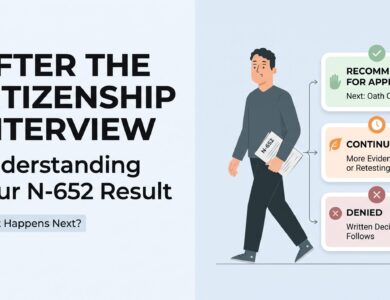
Form N-652: approved, continued or denied
USCIS uses the interview process to tell applicants whether the examination can be completed or whether another step is needed. A case may move toward approval, be continued for additional evidence or retesting, or be denied. The meaning of the notice matters more than a generic “passed interview” label.
If you have already interviewed, use our Form N-652 and post-interview decisions guide for the possible outcomes and next steps.
Approval is not the moment you become a U.S. citizen
USCIS states this clearly: you are not a U.S. citizen until you take the Oath of Allegiance at a naturalization ceremony. After approval, USCIS schedules or provides instructions for the oath. At the ceremony, USCIS reviews the Form N-445 questionnaire, collects the Permanent Resident Card as applicable, administers the oath, and issues the Certificate of Naturalization.
For what to bring, Form N-445, ceremony-day changes and post-naturalization tasks, use our U.S. citizenship oath ceremony guide.
How long does N-400 naturalization take?
There is no reliable single national promise. Naturalization timing can differ by field office and by the facts of the case. Requests for evidence, missed or rescheduled appointments, testing, background checks and ceremony availability can change the path.

Use the live USCIS processing-times tool for Form N-400 and the relevant field office, then track your individual case through your USCIS account and notices. Historic national medians can provide context, but they are not a deadline for a specific application.
What commonly deserves a closer check before filing?
A straightforward N-400 does not require turning every line into a legal investigation. But certain facts are poor candidates for “I will explain it later at the interview.” Get the facts organized before filing if your case includes:
- a long or repeated travel history that may affect residence or physical presence;
- a 3-year spouse case with separation, marital-union questions or timing uncertainty;
- arrests, citations, charges, convictions, probation, parole or incomplete court records;
- false statements, a possible false claim to U.S. citizenship, or voting history that may be legally significant;
- unfiled tax returns, inconsistent tax status, overdue taxes without a clear record, or support obligations;
- a Selective Service issue;
- material differences between the N-400 answers and prior immigration records;
- an unresolved question about whether you were lawfully admitted for permanent residence; or
- any fact that could affect not only naturalization but the underlying Green Card status.
That does not mean every item produces a denial. It means a generic article cannot responsibly tell you the legal consequence without the actual record.
What to check before you submit Form N-400
- Confirm the eligibility basis. Know whether you are using the 5-year route, qualifying 3-year spouse route, military route or another provision.
- Recalculate every relevant trip. Check continuous residence and physical presence separately.
- Verify the filing date. If using early filing, calculate 90 calendar days correctly and confirm the other filing-day requirements.
- Check the current USCIS fee and Form N-400 edition. Do not use the June 2026 proposed fee as if it were already effective.
- Identify the test or exception that applies. A new 2026 filing uses the 2025 civics test under the current rule.
- Review any risk issue before making sworn answers. Criminal, tax, support, Selective Service, travel or prior-immigration issues may need records or individualized advice.
- Gather the evidence triggered by your actual history. Do not submit an oversized generic packet just because another applicant did.
- File only after the unresolved questions are understood. Then preserve a complete copy of exactly what you submitted and keep it updated for the interview.
The official starting points remain the USCIS Form N-400 page, the USCIS Fee Schedule, and USCIS naturalization instructions. Use this pillar to identify the next question; use the specialized guide when that question needs a deeper answer.



2 Comments