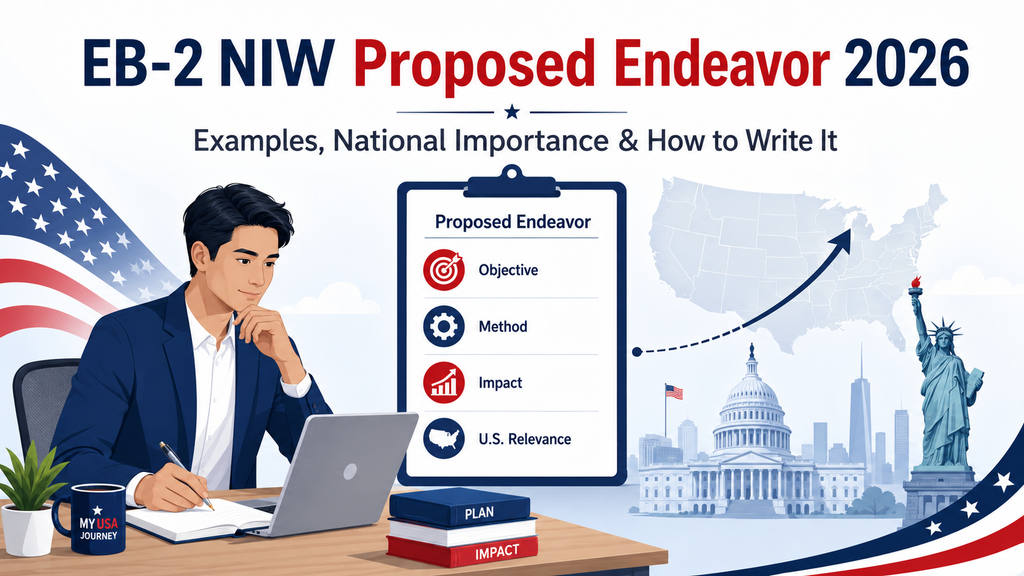
EB-2 NIW proposed endeavor 2026: Examples, National Importance & How to Write It

Your proposed endeavor is one of the most important parts of an EB-2 National Interest Waiver petition. It tells USCIS what you actually intend to do in the United States not simply what your job title is, what industry you work in, or why your profession matters.
This distinction matters because the first Matter of Dhanasar prong focuses on whether the specific proposed endeavor has substantial merit and national importance. A broad statement such as “I am an engineer working in artificial intelligence” may describe your occupation and field, but it does not yet tell USCIS what endeavor you propose to advance.
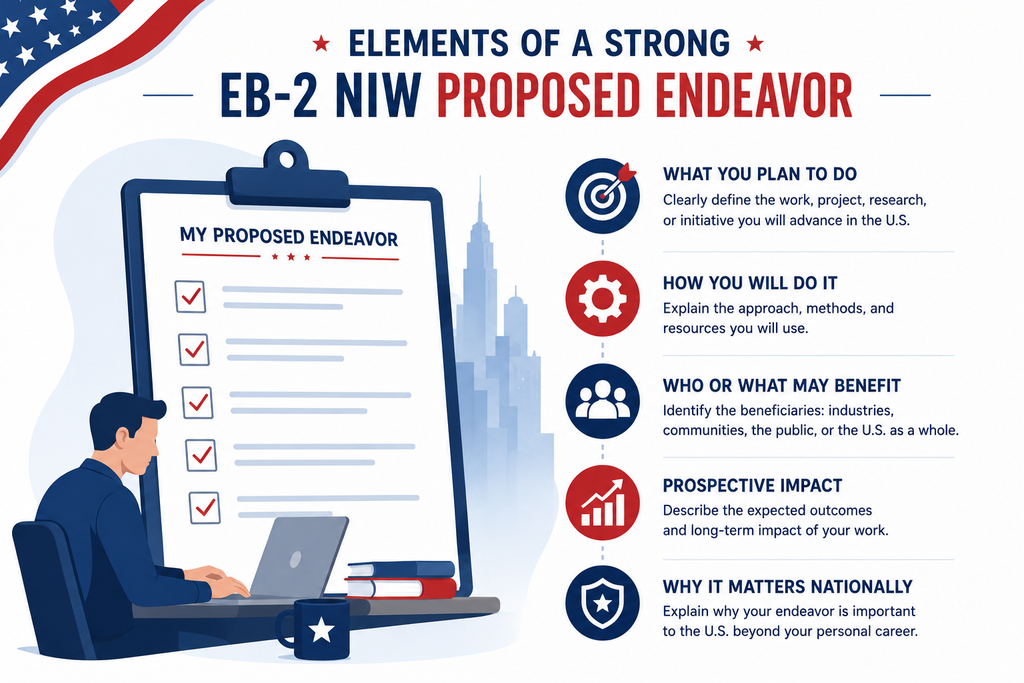
Quick answer: a strong NIW proposed endeavor usually explains what you plan to do, how you plan to do it, who or what may benefit, the prospective impact, and why that impact matters beyond your own career or one ordinary job. It should also remain consistent with the evidence showing that you are well positioned to carry it out.
Last verified: August 26, 2026. USCIS clarified its National Interest Waiver guidance in January 2025 and continues to evaluate the proposed endeavor under the three-prong framework established in Matter of Dhanasar. This article provides educational examples and drafting principles, not individualized legal advice or templates guaranteed to result in approval.
What is a proposed endeavor in EB-2 NIW?
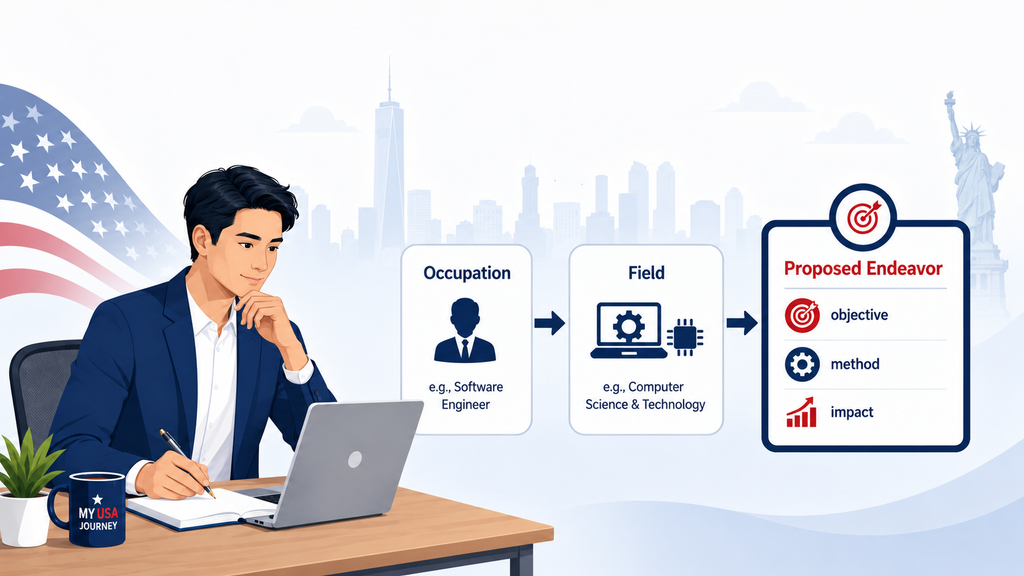
The proposed endeavor is the work, project, research, business activity, initiative, or professional objective that you propose to advance in the United States. It is more specific than your occupation and usually more specific than your field.
| Level | Example | Is this enough by itself? |
|---|---|---|
| Occupation | Electrical engineer | No |
| Field | Power electronics and electric vehicles | No |
| Proposed endeavor | Develop and deploy higher-efficiency power-conversion and inverter technologies intended to improve energy efficiency, reliability, and domestic EV manufacturing capability in the United States | This begins to describe an actual endeavor, but it still needs evidence and case-specific detail |
USCIS’s current NIW guidance distinguishes the proposed endeavor from the general importance of the occupation. The agency examines the endeavor’s prospective impact when deciding whether it has national importance.
If you need the complete eligibility framework first, read our EB-2 NIW Requirements 2026 guide. This article zooms in on the proposed-endeavor portion of that framework.
Why the proposed endeavor matters under Matter of Dhanasar
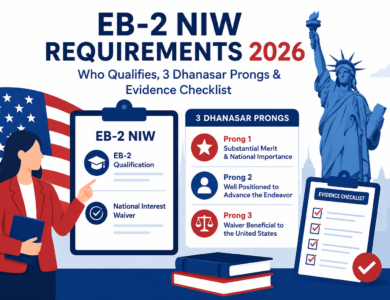
After establishing the underlying EB-2 classification, a petitioner requesting a National Interest Waiver must satisfy all three Dhanasar prongs:
- The proposed endeavor has both substantial merit and national importance;
- The person is well positioned to advance the proposed endeavor;
- On balance, it would benefit the United States to waive the normal job-offer and labor-certification requirements.
The proposed endeavor therefore appears directly in prongs one and two, and indirectly affects the third prong. If the endeavor is vague, it becomes difficult to prove national importance, difficult to show that your past achievements position you to advance it, and difficult to explain why waiving the ordinary labor-certification process benefits the United States.
Occupation vs. field vs. proposed endeavor
This is the distinction to understand before writing anything.
| Statement | What it really describes | Main weakness |
|---|---|---|
| “I am a software engineer.” | Occupation | Does not identify the work you propose to advance |
| “My work is in artificial intelligence.” | Field | Still too broad to evaluate prospective impact |
| “I will develop AI-based diagnostic systems.” | Beginning of an endeavor | Needs details on the problem, users, implementation and prospective impact |
| “I propose to develop and validate AI-assisted diagnostic tools for earlier detection of specific conditions in underserved clinical settings, working with U.S. healthcare and research partners to improve diagnostic efficiency and expand deployment.” | Specific endeavor | Now USCIS can evaluate what the project is and what impact is claimed |
A longer statement is not automatically better. The objective is precision. The officer should be able to understand what you plan to do without reconstructing the endeavor from your résumé, recommendation letters, business plan, and exhibits.
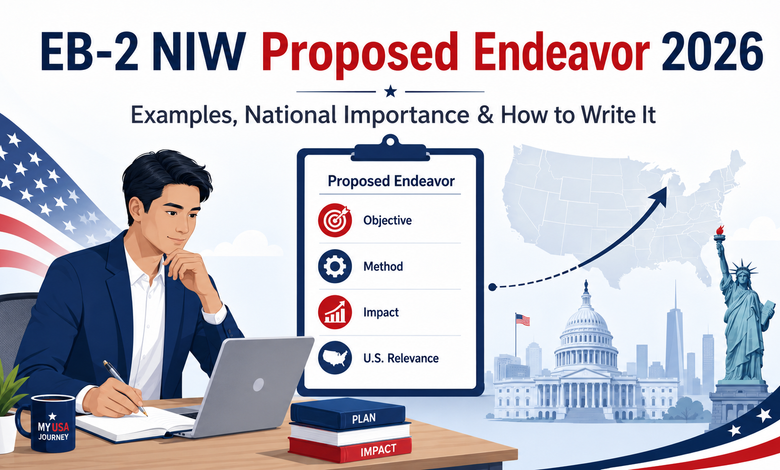
The 5 components of a strong NIW proposed endeavor
There is no official USCIS form containing five mandatory boxes for an endeavor statement. The framework below is a practical drafting method designed to make the endeavor easier to understand and support with evidence.
1. The objective
State what you intend to accomplish. Avoid starting with your biography. Instead of “I have 12 years of experience in cybersecurity,” begin with the work: “My proposed endeavor is to develop and implement cybersecurity methods that improve resilience of [specific systems or users] against [specific class of risks].”
2. The method
Explain how the endeavor will be advanced. Will you conduct research, commercialize a technology, build a company, implement engineering systems, provide specialized services, develop educational programs, collaborate with institutions, or combine several activities? The method connects the objective to actual planned activity.
3. The beneficiaries or users
Identify who or what may benefit: U.S. manufacturers, hospitals, public agencies, critical-infrastructure operators, research institutions, small businesses, specific populations, customers, industries, or a broader technical community. The claimed impact should have a concrete pathway rather than remain abstract.
4. The prospective impact
Describe what could improve if the endeavor advances: efficiency, safety, public health, technological capability, competitiveness, economic output, job creation, research knowledge, cybersecurity, supply-chain resilience, educational outcomes, or another legitimate benefit. Dhanasar makes clear that national importance is evaluated through prospective impact and is not limited to immediate economic value.
5. The U.S. relevance
Explain why the endeavor matters in the U.S. context. Government reports, legislation, agency strategies, federal funding priorities, critical-technology lists, industry data, public-health evidence, or other authoritative material can help establish context when they genuinely relate to the proposed work.
A practical proposed endeavor formula
You should not copy a formula word for word into a petition, but the following structure can help organize the first draft:
I propose to [specific activity or objective] by [method], with the goal of [measurable or identifiable impact] for [beneficiaries/users/field]. The endeavor is intended to address [specific U.S. problem, need, priority or opportunity] through [credible implementation path].
Your evidence then has to support the words inside that sentence. If you claim nationwide deployment but have no credible path to deployment, the statement may become aspirational rather than persuasive.
EB-2 NIW proposed endeavor examples by profile
The examples below are original educational examples. They are not USCIS-approved templates and should not be copied into a real petition without adapting them to the person’s actual work, evidence, and qualifications.
Example 1: electrical / power electronics engineer
Too broad: “I plan to work as an electrical engineer in the electric-vehicle industry.”
Stronger concept: “I propose to develop and implement high-efficiency power-conversion and traction-inverter technologies for electrified transportation, focusing on reducing power losses, improving reliability, and supporting scalable U.S. electric-vehicle and power-electronics manufacturing.”
The stronger version tells USCIS what technological work is proposed and creates a basis for supporting evidence about energy efficiency, vehicle electrification, domestic manufacturing, critical technologies, and the person’s own prior engineering record.
Example 2: artificial intelligence specialist
Too broad: “Artificial intelligence is important and I will work in AI.”
Stronger concept: “I propose to develop and deploy machine-learning systems that improve anomaly detection and predictive maintenance in U.S. industrial operations, with the goal of reducing unplanned downtime and improving the resilience and efficiency of advanced manufacturing systems.”
The improved version does not rely solely on the fact that AI is considered important. It defines a use case and an intended industrial impact.
Example 3: biomedical researcher
Too broad: “I will continue cancer research in the United States.”
Stronger concept: “I propose to investigate specific molecular pathways associated with treatment resistance in [area of research], develop and validate candidate biomarkers, and collaborate with U.S. research institutions to improve the scientific basis for earlier identification of treatment response.”
A research endeavor does not need an immediate commercial return to have substantial merit. The record can focus on scientific importance, the research problem, existing results, collaborations, publications, citations, grants, and prospective contribution to knowledge or health.
Example 4: entrepreneur / startup founder
Too broad: “I want to start a technology company that will create jobs.”
Stronger concept: “I propose to build and scale a U.S.-based platform that helps small and mid-sized manufacturers identify energy losses in industrial equipment and prioritize efficiency upgrades, using proprietary analytics and partnerships with industrial service providers.”
An entrepreneur should support the endeavor with more than projected job numbers. Depending on the case, USCIS may consider funding, customers, revenue, letters of intent, intellectual property, accelerators, contracts, prior entrepreneurial results, market validation, and credible growth plans.
Example 5: healthcare professional
Too broad: “The United States has a healthcare shortage, and I want to work as a healthcare professional.”
Stronger concept: “I propose to develop and implement a specialized care-delivery program focused on [defined patient population or clinical problem], using standardized protocols, training, and measurable quality indicators to improve access and outcomes across participating U.S. healthcare facilities.”
A labor shortage can provide context, but the NIW analysis still asks about the specific endeavor and its prospective impact rather than merely whether employers need workers.
Example 6: education / workforce development
Too broad: “I will teach STEM subjects in the United States.”
Stronger concept: “I propose to design and expand industry-aligned technical training programs in power electronics and electrification, combining curriculum development, laboratory-based instruction, and partnerships with employers to improve the pipeline of workers prepared for advanced manufacturing and transportation-electrification roles.”
The stronger framing creates a possible pathway to national importance through workforce capability and strategic industrial needs, but the petition would still need evidence that the initiative has credible reach and significance.
National importance: what USCIS is actually evaluating
National importance does not necessarily mean the endeavor must physically operate in all 50 states. In Dhanasar, the AAO explained that prospective impact is not evaluated solely in geographic terms. An endeavor focused in one location may still have national importance if it has broader implications.
- national or global implications within a field;
- improved manufacturing or technological processes;
- medical or public-health advances;
- significant potential employment or economic effects;
- critical infrastructure or national-security relevance;
- advancement of scientific or technical knowledge;
- meaningful benefits to an economically depressed area;
- another well-supported prospective impact beyond the ordinary benefit of one job.
There is no single numerical threshold such as “create 10 jobs” or “affect five states.” The analysis is qualitative and evidence-based.
The national-importance evidence ladder
A common NIW mistake is to collect evidence showing that the field is important but never connect it to the proposed endeavor. A stronger evidence chain usually has several levels.
| Level | Question | Evidence example |
|---|---|---|
| 1. U.S. need / priority | Why does the broader problem matter? | Federal policy, agency reports, industry data, public-health data, critical technology priorities |
| 2. Endeavor connection | How does your specific endeavor address that problem? | Technical plan, project description, business plan, research aims, implementation roadmap |
| 3. Prospective impact | What could change if the endeavor succeeds? | Deployment potential, economic modeling, scientific impact, technical performance, user or customer evidence |
| 4. Credible pathway | Why is that impact realistically reachable? | Contracts, collaborations, funding, pilots, traction, prior implementation, institutional support |
If the evidence stops at level one, you may have proven that the topic is important without proving that your endeavor has national importance.
Proposed endeavor evidence matrix
Use this private planning matrix before drafting the petition letter. It is not a USCIS form.
| Claim in endeavor statement | Evidence that could support it | Risk if unsupported |
|---|---|---|
| I will develop a specific technology | Prior prototypes, patents, technical reports, publications, project plans | Statement appears speculative |
| The technology addresses an important U.S. problem | Government reports, agency strategies, industry or scientific evidence | Importance is asserted rather than demonstrated |
| The solution can reach U.S. users or industry | Customers, partners, letters of intent, distribution plan, institutional relationships | Impact pathway is unclear |
| The endeavor can create economic impact | Credible financial projections, current revenue, contracts, hiring plan, market evidence | Job or revenue projections may look speculative |
| I am positioned to execute the plan | Past results, expertise, funding, awards, implementation record, collaborators | Prong 2 remains disconnected from the endeavor |
This matrix forces every important sentence in the endeavor statement to have an evidentiary home.
How the proposed endeavor connects to Dhanasar prong 2
Once USCIS understands the endeavor, the second prong asks whether you are well positioned to advance it. Your strongest achievements are usually the ones that logically connect to the future work.
For example, a patent in power conversion may be relevant to a future power-electronics endeavor. A publication record in an unrelated scientific area may be impressive but less probative if the proposed endeavor concerns a completely different problem.
Our EB-2 NIW RFE guide explains why evidence-to-endeavor connection is a recurring weakness in NIW adjudication.
Can the proposed endeavor be broader than one employer?
Yes. NIW does not require a permanent job offer, and a proposed endeavor can involve work across employers, clients, institutions, collaborations, research programs, or an entrepreneurial venture where the facts support that model.
This can be useful because the endeavor is not necessarily identical to one current job description. However, the petition should still present a credible path. “I may work with many companies someday” is not the same as documenting actual expertise, relationships, demand, partnerships, or a plausible implementation strategy.
Can you change your proposed endeavor after filing?
Be careful. Immigration benefit eligibility generally must exist at the time of filing and continue through adjudication. An RFE response can clarify, explain, and document the originally proposed endeavor, but a petitioner should not assume that a materially different new endeavor can simply replace an ineligible case after filing.
Normal factual developments may occur while a case is pending — new publications, new contracts, additional funding, new implementation results, or other progress — but significant changes should be evaluated carefully for consistency with the petition that was filed.
If the proposed work has materially changed after filing, that is a good point to obtain case-specific legal advice rather than trying to rewrite the case through an RFE response.
How long should a proposed endeavor statement be?
USCIS does not publish a universal word count for a proposed endeavor statement. The right length is the length needed to explain the endeavor clearly and support it with evidence.
A one-paragraph summary can be useful at the beginning of a petition, while a more detailed section can explain implementation, prospective impact, and evidence. Do not add pages simply to make the filing look substantial. Clarity is more valuable than repetition.
Should the proposed endeavor include numbers?
Numbers can be powerful when they are credible. They can describe current results, expected technical performance, market reach, research outputs, customers, hiring, energy savings, production capacity, or another measurable impact.
But unsupported numbers can weaken credibility. A startup claiming it “will create 10,000 jobs” without funding, customers, a realistic hiring model, or market evidence is less persuasive than a smaller projection supported by actual contracts and traction. Use projections as evidence-based estimates, not marketing slogans.
Should you mention federal priorities?
Yes, when there is a genuine connection. Federal policy documents can provide strong context for areas such as critical and emerging technologies, energy security, advanced manufacturing, semiconductor production, cybersecurity, public health, biotechnology, artificial intelligence, or other national priorities.
The mistake is stopping there. A federal strategy saying that semiconductors are important does not prove that every semiconductor worker has a nationally important endeavor. Your petition still needs the bridge from the federal priority to your specific planned work.
Proposed endeavor checklist before filing
- Can a reader understand what I actually propose to do in 2-4 sentences?
- Have I described an endeavor rather than only my occupation?
- Have I identified a credible method or implementation path?
- Do I explain who or what may benefit?
- Do I explain the prospective impact?
- Do my external sources support the specific U.S. problem or priority?
- Have I connected that problem to my actual proposed work?
- Are important projections supported by objective evidence?
- Does my prior record logically connect to the endeavor?
- Are my petition letter, business plan, recommendation letters, résumé, contracts, and project descriptions consistent?
- Would the endeavor still sound nationally important if my job title were removed?
- Could an officer identify what evidence supports each major claim?
Seven common proposed endeavor mistakes
- Describing the occupation instead of the endeavor. “Engineer” or “researcher” does not tell USCIS what you propose to accomplish.
- Relying on the importance of the field. A critical industry does not automatically make every endeavor nationally important.
- Using vague impact language. “Help the economy” or “improve healthcare” is weaker than explaining how the proposed work can create the claimed benefit.
- Writing a marketing pitch. USCIS needs credible evidence, not exaggerated startup language.
- Disconnecting the endeavor from your record. Prong 2 becomes harder when your achievements do not relate to what you now propose.
- Creating inconsistencies across documents. The endeavor should not become a different project in every recommendation letter or business-plan section.
- Trying to repair the entire concept only after an RFE. The strongest time to make the endeavor coherent is before filing.
A simple 4-layer drafting workflow
| Layer | Drafting question | Output |
|---|---|---|
| 1. Endeavor | What exactly will I do? | 2-4 sentence core statement |
| 2. National importance | Why could this specific work matter beyond an ordinary job? | Impact narrative + authoritative sources |
| 3. Well positioned | Why am I credible to execute it? | Evidence map of achievements, resources, progress and relationships |
| 4. Waiver | Why does the U.S. benefit from allowing me to advance it without the normal job-offer/PERM structure? | Case-specific third-prong analysis |
That workflow keeps the petition centered on the legal test instead of becoming a long biography.
How this fits into your complete EB-2 NIW strategy
The proposed endeavor is only one part of a complete NIW case. You still must qualify for the underlying EB-2 classification and satisfy all three Dhanasar prongs.
- Confirm your underlying eligibility using our EB-2 NIW requirements guide.
- Define the proposed endeavor clearly.
- Build evidence for national importance and your ability to advance it.
- Evaluate the third-prong waiver argument.
- Budget the filing using our EB-2 NIW cost guide.
- Understand timing with our EB-2 NIW processing time guide.
- Decide whether premium processing has practical value for your case.
Official sources
- USCIS Policy Manual — Advanced Degree or Exceptional Ability and National Interest Waiver
- USCIS Policy Alert PA-2025-03 — Second Preference Eligibility for NIW Petitions
- Matter of Dhanasar, 26 I&N Dec. 884 (AAO 2016)
- USCIS Administrative Appeals Office — Non-Precedent Decisions
- USCIS — Form I-140, Immigrant Petition for Alien Workers
- eCFR — 8 CFR 103.2, Eligibility and Evidence Rules
- eCFR — 8 CFR 204.5, Employment-Based Immigrant Petitions
FAQ: EB-2 NIW Proposed Endeavor 2026
What is a proposed endeavor for EB-2 NIW?
The proposed endeavor is the specific work, project, research, business activity, or professional objective you intend to advance in the United States. It is more specific than your job title or general field.
Is my job title the same as my proposed endeavor?
No. A job title describes an occupation. USCIS evaluates the specific proposed endeavor and its prospective impact under Matter of Dhanasar.
How specific should an NIW proposed endeavor be?
It should be specific enough for USCIS to understand what you plan to do, how you plan to advance it, who or what may benefit, and what prospective impact you claim. There is no universal required word count.
Does my proposed endeavor need to operate nationwide?
No. Matter of Dhanasar explains that national importance is not evaluated solely in geographic terms. An endeavor concentrated in one area can still have broader national implications.
Can a local business qualify as a nationally important endeavor?
Potentially, but local operation alone does not establish national importance. The evidence should show broader prospective implications, significant economic effects, job creation, important technology, public benefit, or another nationally relevant impact supported by the facts.
Can I use a federal priority to prove national importance?
Federal policies and agency priorities can provide useful context when they genuinely relate to the endeavor. They do not automatically prove that every person working in the priority field has a nationally important endeavor.
Can I change my proposed endeavor after filing the I-140?
Eligibility generally must exist at filing and continue through adjudication. New evidence can document progress, but a materially different endeavor may create eligibility issues. Significant changes should be evaluated carefully.
Do I need a business plan for my proposed endeavor?
Not every NIW case requires a business plan. Entrepreneurs often use one to explain the endeavor, market, implementation and projections, while researchers or employed professionals may rely on different documentation.
Should I include job-creation numbers in my NIW endeavor?
Only when they are relevant and credibly supported. Unsupported projections can weaken the record. Job creation is one possible form of impact, not a mandatory NIW requirement.
What is the biggest mistake in an NIW proposed endeavor?
A common mistake is proving that the industry or occupation is important without showing why the petitioner’s specific proposed endeavor has substantial merit and national importance.