EB-2 NIW Requirements 2026: Who Qualifies, 3 Dhanasar Prongs & Evidence Checklist

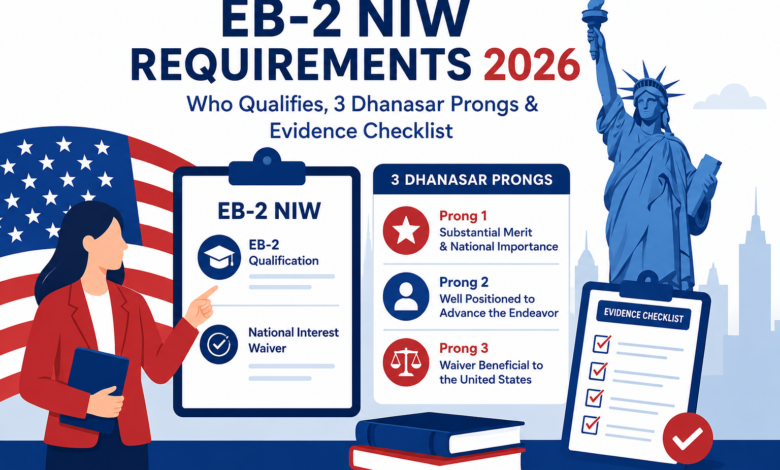
EB-2 NIW is not a single eligibility test. To qualify, you must first fit the underlying EB-2 classification and then separately prove that waiving the normal job-offer and labor-certification requirements is in the national interest of the United States.
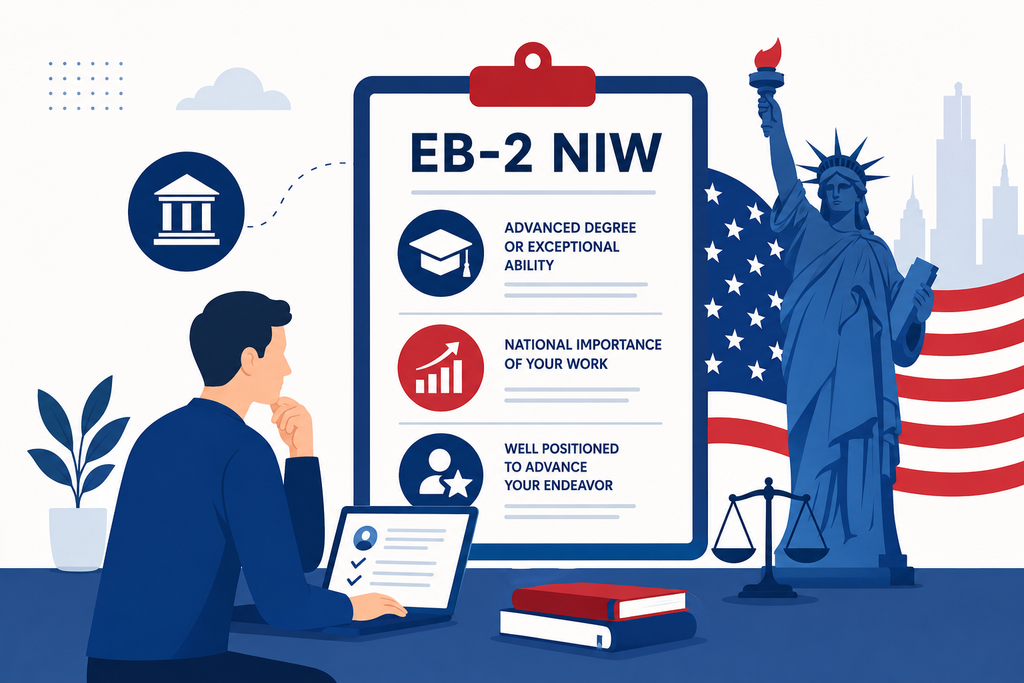
That distinction is where many NIW explanations become misleading. A master’s degree does not automatically qualify you for a National Interest Waiver. Ten years of experience does not automatically qualify you either. USCIS looks first at whether you qualify for EB-2 as an advanced-degree professional or a person of exceptional ability, and then applies the three-prong framework from Matter of Dhanasar.
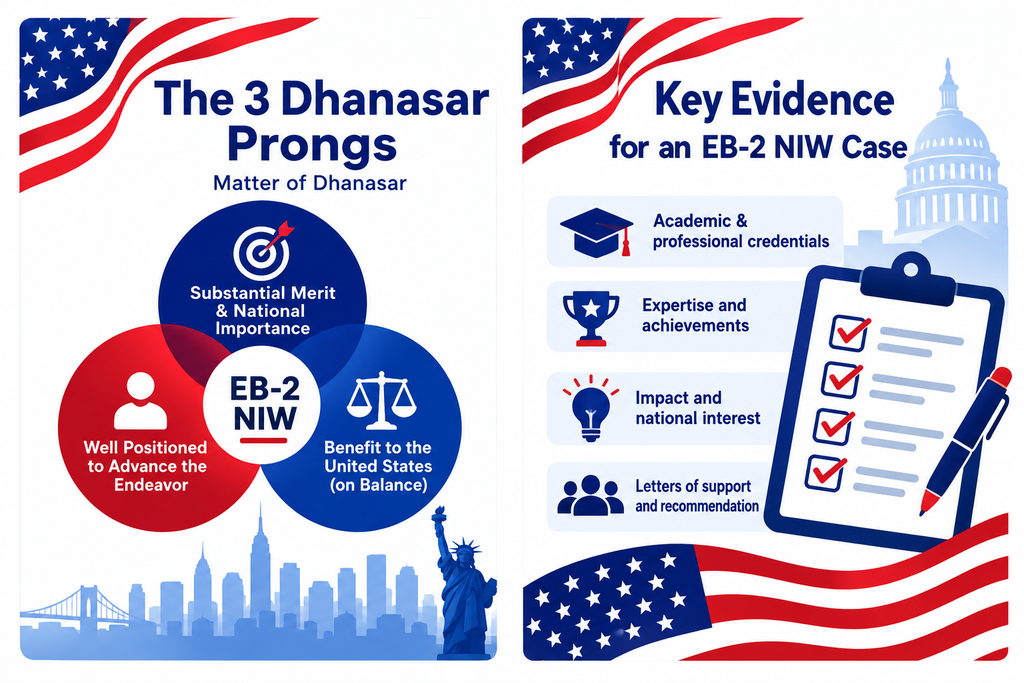
Quick answer: an EB-2 NIW case usually requires two layers of proof: (1) underlying EB-2 eligibility through an advanced degree or exceptional ability, and (2) all three Dhanasar prongs substantial merit and national importance, being well positioned to advance the proposed endeavor, and showing that, on balance, the United States would benefit from waiving the job-offer and labor-certification requirements.
Last verified: August 22, 2026. USCIS issued a major NIW policy clarification on January 15, 2025, including more detailed guidance on advanced-degree professionals, exceptional ability, STEM cases, entrepreneurs, the proposed endeavor, and evidence. This guide reflects that framework. It is educational information, not individualized legal advice.
EB-2 NIW requirements in one table
| Layer | What you must show | Can you skip it? |
|---|---|---|
| EB-2 classification | Advanced-degree professional OR person of exceptional ability | No |
| Dhanasar prong 1 | Your specific proposed endeavor has substantial merit and national importance | No |
| Dhanasar prong 2 | You are well positioned to advance that proposed endeavor | No |
| Dhanasar prong 3 | On balance, waiving the job offer and labor certification would benefit the United States | No |
Think of NIW eligibility as a sequence. If you fail the underlying EB-2 classification, USCIS does not have to approve the waiver merely because your work sounds important. If you qualify for EB-2 but fail one of the Dhanasar prongs, you still do not qualify for the National Interest Waiver.
If you already understand the eligibility standard and are focused on timing, see our EB-2 NIW processing time guide. This page focuses on whether the case itself meets the legal framework.
Step 1: qualify for the underlying EB-2 category
USCIS first asks whether you qualify for the employment-based second preference category. There are two main routes:
- Advanced degree: you are a member of the professions holding an advanced degree or its equivalent; or
- Exceptional ability: you have a degree of expertise significantly above that ordinarily encountered in the sciences, arts, or business.
You do not need to qualify under both routes. One can be enough. But the evidence for each route is different, and USCIS clarified in 2025 that the advanced degree or exceptional ability must be meaningfully connected to the occupation and proposed endeavor being advanced through the NIW request.
Advanced degree route: what counts?
Under the regulations, an advanced degree is a U.S. academic or professional degree — or a foreign equivalent degree — above the baccalaureate level.
USCIS also treats a U.S. bachelor’s degree or foreign equivalent followed by at least five years of progressive post-baccalaureate experience in the specialty as the equivalent of an advanced degree for EB-2 purposes.
| Possible route | Typical evidence | Important issue |
|---|---|---|
| U.S. master’s, doctorate, or other qualifying advanced degree | Official academic records | The degree must support qualification for the relevant profession/occupation |
| Foreign equivalent advanced degree | Foreign degree + transcripts + reliable credential evidence where needed | USCIS must be able to determine U.S. equivalency |
| Bachelor’s + 5 years progressive experience | Degree records + employer letters documenting progressive post-baccalaureate experience | The experience must be in the specialty and progressively responsible |
A bachelor’s degree alone is not an advanced degree
A bachelor’s degree can form the basis of the equivalency route only when the required five years of progressive post-baccalaureate experience are also established. Simply having many years of work experience before the bachelor’s degree does not automatically satisfy that specific regulatory route.
The occupation must be a profession
USCIS’s January 2025 policy update emphasized that, in an NIW case without a labor certification specifying job requirements, the petitioner still has to establish that the occupation underlying the advanced-degree claim is a profession. USCIS looks at whether a bachelor’s degree or foreign equivalent is normally the minimum requirement for entry into that occupation or whether the occupation otherwise falls within the statutory definition of a profession.
Exceptional ability route: the six regulatory criteria
Exceptional ability means expertise significantly above that ordinarily encountered in the sciences, arts, or business. The regulations list six types of evidence. At the initial evidentiary step, a petitioner generally must satisfy at least three.
- An official academic record showing a degree, diploma, certificate, or similar award relating to the area of exceptional ability;
- Letters from current or former employers showing at least 10 years of full-time experience in the occupation;
- A license to practice the profession or certification for the profession or occupation;
- Evidence that you commanded a salary or other remuneration demonstrating exceptional ability;
- Membership in professional associations;
- Recognition for achievements and significant contributions by peers, governmental entities, or professional or business organizations.
If these criteria do not readily apply to the occupation, the regulations allow comparable evidence in appropriate cases.
Meeting three criteria is not automatically enough
This point is critical. Satisfying three listed criteria does not necessarily end the exceptional-ability analysis. USCIS evaluates the evidence in its totality to determine whether it actually shows a degree of expertise significantly above that ordinarily encountered in the field.
For example, ordinary membership in a professional association may satisfy the wording of one criterion in some circumstances, but it may carry limited weight if practically everyone in the profession can join. The overall quality and meaning of the evidence matter.
Your exceptional ability must relate to the proposed endeavor
The 2025 USCIS policy update expressly emphasized the connection between exceptional ability and the proposed NIW endeavor. USCIS considers whether the area in which you claim exceptional ability and the endeavor share relevant skills, knowledge, or expertise.
Being exceptional in one field does not automatically establish EB-2 eligibility for a completely unrelated endeavor.
Step 2: pass all three Matter of Dhanasar prongs
Qualifying for EB-2 gets you only through the first gate. The National Interest Waiver is a separate discretionary benefit. USCIS applies the three-prong framework established in Matter of Dhanasar, 26 I&N Dec. 884 (AAO 2016).
The burden is on the petitioner to establish eligibility by a preponderance of the evidence — essentially, that the claimed facts are more likely than not true based on the record as a whole.
Prong 1: substantial merit and national importance
The first prong contains two concepts: substantial merit and national importance. Both must be addressed.
Substantial merit
The endeavor can have substantial merit in areas such as business, entrepreneurship, science, technology, culture, health, or education. Economic impact can be relevant, but USCIS does not require every meritorious endeavor to produce immediate quantifiable economic benefits.
National importance
National importance is where many petitions become more difficult. USCIS focuses on the specific proposed endeavor and its prospective impact, not merely the importance of the occupation or industry.
This distinction is explicit in current USCIS guidance. “Engineering” is an occupation. “Artificial intelligence” is a field. Neither description alone tells USCIS what you specifically propose to do. A strong NIW filing explains the actual projects, goals, methods, expected reach, beneficiaries, and broader implications of the endeavor.
| Weak framing | Stronger framing concept |
|---|---|
| “Cybersecurity is important to the United States.” | Explain the specific cybersecurity endeavor, its users, technical objective, prospective reach, and why the expected impact matters nationally. |
| “There is a shortage of nurses.” | Explain the specific healthcare endeavor and how its prospective impact extends beyond filling one local job. |
| “AI is a critical technology.” | Show what AI work you actually propose, where it fits within a recognized U.S. priority, and why the endeavor itself has broader implications. |
| “My company will create jobs.” | Provide credible evidence and projections showing how the specific venture could create significant economic or employment effects. |
A labor shortage can support context, but USCIS has repeatedly explained that shortage evidence by itself does not automatically establish national importance. The NIW analysis is not simply a substitute for proving that employers need workers.
Prong 2: you are well positioned to advance the endeavor
The second prong asks whether you are well positioned to move the proposed endeavor forward. USCIS does not require proof that success is guaranteed. The question is whether the record shows a credible ability to advance the plan.
Depending on the case, evidence may include:
- Education, specialized training, and relevant technical knowledge;
- A record of success in similar or related efforts;
- Publications, citations, patents, intellectual property, or technology transfer;
- Awards, recognition, media coverage, or invitations relevant to the endeavor;
- Funding, grants, investments, revenue, customer traction, contracts, or purchase commitments;
- Letters showing government, institutional, industry, or expert interest;
- A detailed plan showing progress already made and credible next steps;
- Evidence of collaborators, partners, institutions, users, or stakeholders;
- Prior results demonstrating that you can execute work comparable to the proposed endeavor.
A degree by itself is not enough to prove that you are well positioned. USCIS specifically says that education can be relevant, especially in STEM cases, but the petition should connect credentials to the actual endeavor and the rest of the record.
Prong 3: why should USCIS waive the normal job-offer process?
The third prong is a balancing test. USCIS asks whether the benefits of granting the waiver outweigh the benefits normally provided by the job-offer and labor-certification process.
This does not mean you must prove that no U.S. worker could perform the work. That would largely recreate the labor-certification framework the NIW is designed to potentially waive.
Instead, the record can address factors such as:
- Why it may be impractical for the petitioner to secure a traditional job offer or labor certification given the nature of the endeavor;
- Why the United States would benefit from the person’s contributions even if other qualified U.S. workers are available;
- Whether the national interest in the person’s contributions is sufficiently urgent;
- Whether the person is an entrepreneur or self-employed in a way that does not fit the normal labor-certification model;
- Whether the endeavor creates or supports jobs, economic activity, technology, research, public benefit, or other national interests that weigh in favor of the waiver.
The third prong should not be a generic paragraph pasted into every NIW petition. It should explain why the waiver makes sense for this person and this proposed endeavor.
Do you need a job offer for EB-2 NIW?
No. One of the central features of the National Interest Waiver is that USCIS can waive the normal job-offer requirement and therefore the permanent labor certification requirement. NIW petitioners may self-petition using Form I-140.
But “no job offer required” does not mean “no career plan required.” USCIS still expects a credible proposed endeavor. Evidence of employment, prospective employers, customers, collaborators, contracts, research affiliations, or business plans can still be highly relevant to showing what you intend to do and whether you are well positioned to do it.
Do you need PERM labor certification for EB-2 NIW?
No, if USCIS grants the National Interest Waiver. The purpose of the NIW is to waive the job-offer requirement and the associated permanent labor certification requirement when the waiver is in the national interest.
This is different from a standard employer-sponsored EB-2 case, where the employer normally completes the Department of Labor permanent labor certification process before filing Form I-140.
Do you need publications or citations?
No regulation says that every EB-2 NIW applicant must have publications or citations. Those forms of evidence can be valuable for researchers and academics, but the NIW framework applies to many types of professionals, entrepreneurs, scientists, engineers, businesspeople, and other qualifying applicants.
The correct question is whether the available evidence proves the legal requirements in your field. A founder may rely more heavily on business traction, investment, contracts, product adoption, job creation, and expert or government interest. An engineer may rely on project impact, patents, technical leadership, implementation results, and evidence of the importance of the specific endeavor.
Do you need recommendation letters?
Recommendation letters are not a standalone statutory requirement for every NIW petition. They are evidence tools. Their value depends on what they prove.
A useful letter can explain a specific contribution, the importance of the proposed endeavor, the writer’s basis of knowledge, your record of success, or why a government or industry stakeholder has an interest in the work. A vague letter that only calls you “excellent” adds much less.
Letters from interested U.S. government agencies or quasi-governmental entities can be especially relevant when they explain how the endeavor advances a government interest, but they are not mandatory in every case.
Special consideration for STEM professionals
USCIS policy gives specific guidance for STEM cases. An advanced STEM degree, particularly a Ph.D., can be an important positive factor when the proposed endeavor concerns a critical and emerging technology or another STEM area important to U.S. competitiveness or national security and the person is well positioned to advance it.
But a STEM degree is not an automatic NIW approval. USCIS still evaluates the specific endeavor and all three Dhanasar prongs. The January 2025 policy clarification expressly states that a degree by itself is not sufficient to establish that the person is well positioned.
Special consideration for entrepreneurs and startup founders
Entrepreneurs can qualify for NIW, but they do not receive a separate easier legal standard. The same EB-2 and Dhanasar framework applies.
USCIS recognizes that entrepreneurial evidence can look different from academic evidence. Relevant documentation may include:
- Investment or funding;
- Revenue and commercial traction;
- Customer or user adoption;
- Contracts, purchase commitments, or letters of intent;
- Accelerator or incubator participation;
- Intellectual property;
- Job-creation plans supported by credible evidence;
- Outside investment or government grants;
- Evidence that the entrepreneur has previously built or scaled related ventures.
A business plan can help explain the endeavor, but a polished plan containing unsupported projections is not the same as objective evidence. USCIS evaluates the whole record.
EB-2 NIW self-screening checklist
This checklist cannot predict approval, but it can help identify whether the basic architecture of a potential case exists before you spend time assembling hundreds of pages.
| Question | Yes / No | Why it matters |
|---|---|---|
| Do I clearly qualify through advanced degree or exceptional ability? | □ | Underlying EB-2 is mandatory. |
| Can I describe my proposed endeavor in 2-4 specific sentences? | □ | USCIS evaluates the endeavor, not merely the occupation. |
| Can I prove substantial merit with objective evidence? | □ | Required under prong 1. |
| Can I explain why the endeavor has broader prospective impact or national importance? | □ | Industry importance alone is insufficient. |
| Do I have evidence connecting my past record to the future endeavor? | □ | Central to prong 2. |
| Is there evidence of progress, traction, recognition, funding, implementation, or stakeholder interest? | □ | Can strengthen “well positioned.” |
| Can I explain why waiving the job offer and labor certification benefits the United States? | □ | Required under prong 3. |
| Are my claims supported by independent or verifiable records? | □ | Unsupported assertions carry limited weight. |
| Are the proposed endeavor, résumé, letters, business plan, and supporting records consistent with each other? | □ | Contradictions can undermine credibility. |
| Do I know which weaknesses USCIS could reasonably question? | □ | Helps identify evidence gaps before filing. |
If you answer “no” to several required legal elements, the solution is not necessarily to collect more recommendation letters. It may mean the proposed endeavor needs to be clarified, the evidence is premature, or another immigration category fits better.
Evidence checklist by legal requirement
| Requirement | Examples of potentially useful evidence |
|---|---|
| Advanced degree | Diploma, official transcript, foreign-equivalency evidence, employer experience letters for bachelor’s + 5 route |
| Exceptional ability | Evidence satisfying at least 3 regulatory categories, plus evidence showing expertise significantly above ordinary levels |
| Proposed endeavor | Detailed endeavor statement, research plan, business plan, project roadmap, contracts, implementation documents |
| Substantial merit | Government or industry reports, technical evidence, public-health or economic evidence, expert documentation |
| National importance | Evidence of broader prospective impact, national or global implications, economic scale, critical technology relevance, significant public benefit |
| Well positioned | Past achievements, project outcomes, publications, patents, citations, revenue, funding, awards, implementation, letters, partnerships |
| Third prong | Case-specific explanation and evidence showing why waiver of job offer/PERM better serves the U.S. interest |
What does not automatically qualify you for EB-2 NIW?
- A master’s degree alone. It may establish part of the underlying EB-2 requirement, not the NIW prongs.
- A Ph.D. alone. A doctorate can be powerful evidence, especially in relevant STEM work, but the specific endeavor and all three prongs still matter.
- Working in an important industry. USCIS evaluates the specific proposed endeavor.
- A labor shortage alone. NIW national importance is not identical to showing employer demand.
- Many recommendation letters. Volume does not replace substantive evidence.
- Three exceptional-ability criteria without strong totality evidence. Meeting the initial criteria does not automatically finish the analysis.
- A business plan with unsupported projections. USCIS weighs credibility and objective evidence.
- Premium processing. It changes speed, not the legal standard or strength of the petition.
If USCIS has already challenged your evidence, use our EB-2 NIW RFE guide to understand recurring problem areas and how to organize a response.
Can you self-petition for EB-2 NIW?
Yes. A person seeking a National Interest Waiver may file Form I-140 on their own behalf. This is one of the major differences between NIW and a standard employer-sponsored EB-2 case.
Self-petitioning does not mean USCIS lowers the evidentiary standard. You still carry the burden of proving the underlying EB-2 classification and the national-interest waiver.
Does EB-2 NIW give you a Green Card immediately?
No. Form I-140 approval establishes the immigrant petition. It does not necessarily mean an immigrant visa number is immediately available or that permanent residence has been granted.
Your full timeline can include:
- Preparing and filing the EB-2 NIW Form I-140;
- USCIS adjudicating the petition;
- Waiting for the priority date if the Visa Bulletin category is backlogged;
- Completing Form I-485 adjustment of status or immigrant-visa processing;
- Final admissibility, medical, security, interview, and discretionary review where applicable.
Our green-card pathways comparison explains why petition approval, visa availability, and final permanent-residence processing are different clocks.
Can you use premium processing?
Yes. Eligible EB-2 NIW I-140 petitions may use premium processing through Form I-907. As of 2026, the NIW premium-processing service period is 45 business days for qualifying adjudicative action.
Premium processing does not improve your eligibility. USCIS can approve, deny, issue an RFE, issue a Notice of Intent to Deny, or take another qualifying action within the premium-processing framework.
For the current fee, 45-business-day rule, RFE clock, and whether upgrading makes sense, see our EB-2 NIW premium processing guide.
Common EB-2 NIW eligibility mistakes
- Starting with your résumé instead of the legal framework. Strong credentials are useful only when they prove the required elements.
- Confusing occupation with proposed endeavor. “Engineer” is not an endeavor statement.
- Proving the field is important but not the project. USCIS evaluates prospective impact of the specific endeavor.
- Using generic letters. Letters should add facts, analysis, or independent support rather than repeat the petitioner’s claims.
- Ignoring the underlying EB-2 test. NIW does not waive the advanced-degree or exceptional-ability requirement.
- Assuming three exceptional-ability criteria equal approval. USCIS evaluates the totality of the evidence.
- Leaving the third prong generic. Explain why waiver of the normal process is beneficial in your actual circumstances.
- Submitting unsupported future projections. A plan becomes stronger when backed by traction, funding, contracts, technical milestones, credible market evidence, or other objective proof.
A practical way to decide whether an NIW case is ready
Before filing, organize your evidence into four folders rather than one giant “achievements” folder:
- EB-2 qualification: proof of advanced degree or exceptional ability;
- Endeavor and national importance: proof of what you will do and why its prospective impact matters;
- Well positioned: proof that your record, resources, progress, and relationships make execution credible;
- Waiver balancing: proof and explanation showing why the national benefit of waiving the normal job-offer/PERM process outweighs retaining it.
If most of your evidence falls into only one folder — for example, a strong résumé but almost nothing explaining national importance — the case may not yet be balanced enough.
Official sources
- USCIS Policy Manual — Advanced Degree or Exceptional Ability
- USCIS Policy Alert PA-2025-03 — Second Preference Eligibility for NIW Petitions
- USCIS — Form I-140, Immigrant Petition for Alien Workers
- eCFR — 8 CFR 204.5, Employment-Based Immigrant Petitions
- Matter of Dhanasar, 26 I&N Dec. 884 (AAO 2016)
- DOJ EOIR — DHS/AAO/INS Precedent Decisions
- USCIS AAO — Non-Precedent Decisions
FAQ: EB-2 NIW Requirements 2026
What are the basic EB-2 NIW requirements in 2026?
You must first qualify for the underlying EB-2 category as an advanced-degree professional or person of exceptional ability. You must then satisfy all three Matter of Dhanasar prongs: substantial merit and national importance, being well positioned to advance the proposed endeavor, and showing that waiving the job-offer and labor-certification requirements would benefit the United States.
Is a master’s degree enough for EB-2 NIW?
No. A qualifying advanced degree may establish the underlying EB-2 classification, but you must separately satisfy all three National Interest Waiver prongs.
Can I qualify for EB-2 NIW without a master’s degree?
Possibly. One route is a bachelor’s degree or foreign equivalent plus at least five years of progressive post-baccalaureate experience in the specialty. Another route is qualifying as a person of exceptional ability under the EB-2 rules.
Do I need publications or citations for EB-2 NIW?
No rule requires every NIW applicant to have publications or citations. Those forms of evidence can be useful in research cases, but other professions and entrepreneurs may rely on different evidence tied to the legal requirements.
Do I need a job offer for EB-2 NIW?
No. A National Interest Waiver can waive the job-offer and labor-certification requirements, and qualifying applicants may self-petition using Form I-140.
Do I need PERM for EB-2 NIW?
No, if USCIS grants the National Interest Waiver. The waiver removes the normal job-offer and permanent labor-certification requirement for that NIW petition.
What are the three Dhanasar prongs?
The proposed endeavor must have substantial merit and national importance; the person must be well positioned to advance the endeavor; and, on balance, it must benefit the United States to waive the job-offer and labor-certification requirements.
Can entrepreneurs qualify for EB-2 NIW?
Yes, entrepreneurs can qualify if they meet the underlying EB-2 requirement and all three Dhanasar prongs. USCIS recognizes that entrepreneurial evidence can include funding, revenue, traction, contracts, intellectual property, job creation and other objective indicators.
Does a STEM degree guarantee NIW approval?
No. USCIS gives specific consideration to certain STEM endeavors, especially those relevant to critical technologies, competitiveness or national security, but a STEM degree alone does not satisfy the complete NIW standard.
How many exceptional ability criteria do I need?
The regulations generally require evidence satisfying at least three of six listed criteria at the initial step. Meeting three criteria does not automatically establish exceptional ability; USCIS then evaluates the evidence in its totality.
Can I self-petition for EB-2 NIW?
Yes. A person requesting a National Interest Waiver may file Form I-140 on their own behalf without a sponsoring employer.
Does premium processing make it easier to qualify?
No. Premium processing changes the speed of USCIS action, not the EB-2 NIW legal standard or evidentiary burden.