U.S. Citizenship Interview Questions: N-400 Review and Civics Test

Last verified: July 27, 2026. A U.S. citizenship interview is not a separate quiz with one fixed list of personal questions. A USCIS officer places the applicant under oath, reviews the answers in Form N-400, tests whether the applicant still qualifies for naturalization, and usually administers the English and civics tests. The questions therefore depend on the application, immigration history, travel, family situation, taxes, arrests, organizations, and any changes since filing.
U.S. Citizenship Interview Questions: N-400 Review and Civics Test
The most effective preparation is not memorizing a script. It is reading the exact N-400 version you submitted, checking every answer against current facts, gathering records for anything that needs clarification, and practicing truthful answers in clear English. A small inconsistency is not automatically fatal, but guessing, hiding a material fact, or repeating an answer you know is wrong can create a much more serious problem.
What happens at a U.S. citizenship interview?
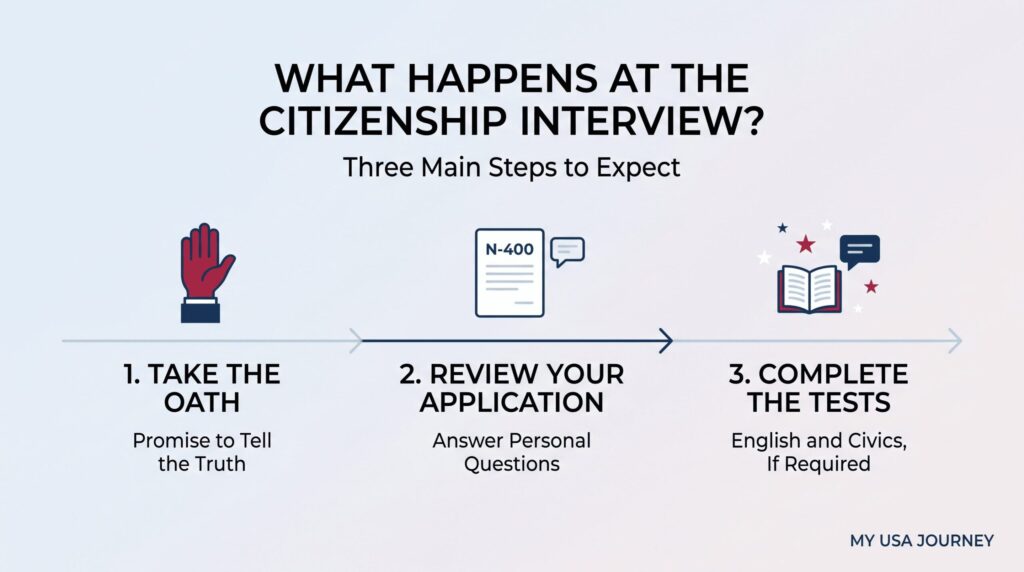
USCIS schedules the naturalization examination after Form N-400 is filed and the required background checks are underway. The appointment notice identifies the field office, date, and time. At the office, security and check-in can add time before the interview itself. The officer verifies identity, administers an oath to tell the truth, and reviews the application and supporting evidence.
The same conversation also serves as the English speaking test for applicants who do not qualify for an English-language exemption. The officer is not grading accent or demanding perfect grammar. The question is whether the applicant can understand and respond to ordinary English used during the eligibility review. Reading, writing, and civics are tested separately.
| Interview stage | What the officer is checking | How to prepare |
|---|---|---|
| Identity and oath | Identity documents and truthful testimony | Bring the notice, Green Card, photo ID, passports, and requested originals |
| N-400 review | Eligibility and whether answers remain accurate | Review a complete copy and list every change since filing |
| English test | Speaking, reading, and writing ability unless exempt | Practice USCIS vocabulary and official exercises |
| Civics test | Knowledge of U.S. history and government | Study the correct test based on the N-400 filing date |
| Decision | Whether the case can be approved now | Understand Form N-652 and respond promptly to any evidence request |
Are citizenship interview questions the same for everyone?
No. Form N-400 creates the framework, but the follow-up questions are case-specific. Two applicants may both be applying under the five-year rule and receive different questions because one traveled frequently, another changed jobs after filing, and a third disclosed an old arrest. The officer may move quickly through straightforward sections and spend more time where the record is incomplete, inconsistent, or legally significant.
USCIS educational materials contain useful practice exercises, but they are not a promise that an officer will use identical wording. Applicants should understand the meaning of their own answers. Memorizing “yes” or “no” without understanding the question is especially risky in the eligibility and good-moral-character sections.
Questions about your identity and basic information
The interview commonly begins with simple identity questions. These help the officer confirm the applicant and begin evaluating spoken English. The officer may ask for the applicant’s full legal name, date of birth, country of birth, current address, phone number, and other names used in the past.
- What is your full legal name?
- Have you ever used another name or a different spelling?
- When and where were you born?
- What is your current home address?
- How long have you lived there?
- Has your address changed since you filed Form N-400?
- Do you want to request a legal name change, where that option is available?
Answer with the current truth, even when it differs from the application. Bring documentation for a legal name change, marriage, divorce, or other event that explains the difference. A routine update is usually handled during the interview; the problem is allowing an incorrect answer to remain after recognizing it.
Questions about your Green Card and immigration history
The officer may confirm when and how the applicant became a lawful permanent resident, whether conditional residence was involved, and whether any prior immigration applications contained inconsistent information. Applicants should know their “resident since” date and the category through which residence was obtained.
- When did you become a lawful permanent resident?
- How did you obtain your Green Card?
- Have you ever claimed to be a U.S. citizen?
- Have you ever voted in a federal, state, or local election in the United States?
- Have you ever been placed in removal, exclusion, or deportation proceedings?
- Have you ever abandoned or been found to have abandoned permanent residence?
- Did you give the same information in earlier immigration filings?
False claims to U.S. citizenship, unlawful voting, removal history, and fraud findings can have consequences far beyond a delayed naturalization application. An applicant who is unsure how an old filing described a marriage, job, child, arrest, or entry should obtain the records and seek qualified legal advice before the interview rather than improvise.
Questions about addresses, work, and school
Form N-400 asks for address and employment or school history over the relevant period. The officer may use these answers to confirm residence, travel patterns, tax history, and eligibility under a special naturalization provision. Exact day-by-day recall is not always realistic, but the timeline should be honest and reasonably consistent with records.
- Where have you lived during the required statutory period?
- Where do you work now?
- When did you begin that job?
- Did you work outside the United States?
- Were there periods when you were unemployed, self-employed, or studying?
- Has your employer, occupation, or school changed since filing?
Useful records can include leases, tax transcripts, pay statements, school records, and a written timeline. Do not invent dates to make a gap disappear. If an estimate was used on the application, explain that it was an estimate and provide the best corrected date available.
Travel questions and absences from the United States
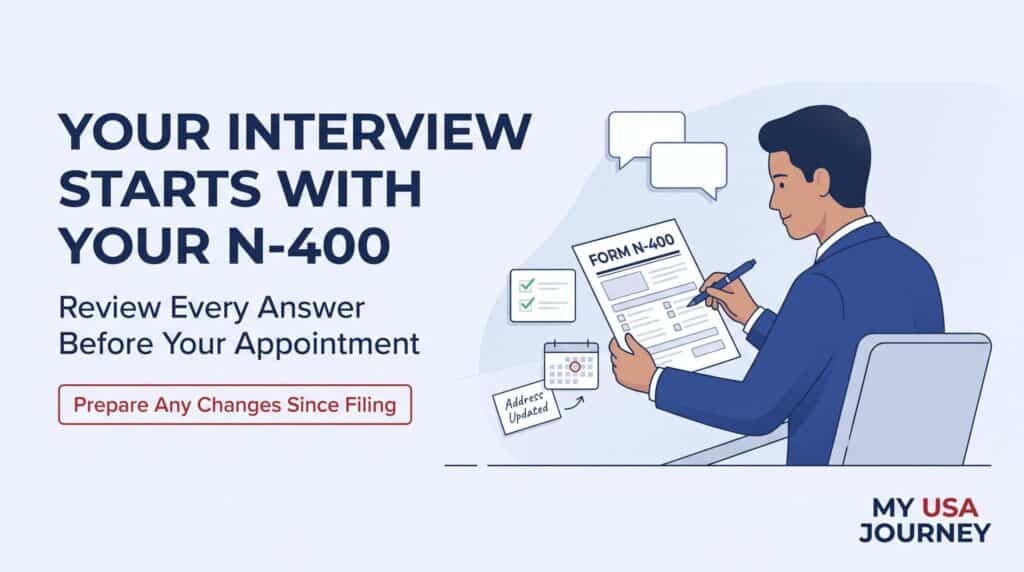
International travel is one of the most common areas for detailed review. The officer compares the trips listed in Form N-400 with passports, travel documents, government records, and the eligibility rules. Bring every valid and expired passport or travel document that records absences since becoming a permanent resident, as USCIS instructs.
- How many trips outside the United States did you take?
- What was the longest trip?
- Why did you travel?
- Where did you stay and work during a long absence?
- Did you keep a U.S. home, job, bank activity, and tax filing during that period?
- Have you traveled after submitting Form N-400?
- Do the new trips change your physical-presence total?
A trip after filing must still be disclosed. Applicants should update their travel table before the appointment and recalculate eligibility. Our separate guide explains how USCIS distinguishes continuous residence from physical presence, including absences of more than six months, absences of one year or more, and the counting of departure and return days.
Marriage, divorce, children, and family questions
Family questions can confirm identity, household history, child-support obligations, and eligibility under the three-year rule for spouses of U.S. citizens. An applicant using that rule should be ready to show that the U.S.-citizen spouse has remained a citizen and that the couple has lived in marital union during the required period, subject to the applicable legal standards.
- What is your current marital status?
- When and where did you marry?
- Is your spouse a U.S. citizen, and when did the spouse become one?
- Have either of you been married before?
- Do you live together?
- Do you have children, including children living elsewhere?
- Are you meeting all court-ordered child or spousal support obligations?
- Has there been a separation, divorce, or death since filing?
Bring certified marriage, divorce, annulment, or death records when they are relevant and were not already accepted in the record. A separation during a three-year spouse-based case can affect the legal basis for eligibility even if no divorce has been filed.
Taxes and financial-support questions
USCIS may examine whether the applicant filed required tax returns, represented themselves consistently as a resident, and complied with support obligations. Tax problems do not all produce the same result. A properly documented payment agreement is different from deliberately failing to file or giving conflicting information to tax and immigration authorities.
- Have you filed all required federal, state, and local tax returns?
- Did you ever file as a nonresident after becoming a permanent resident?
- Do you owe overdue taxes?
- Do you have an approved payment plan, and are payments current?
- Have you supported your dependents as required?
Tax transcripts are often clearer than carrying only self-prepared copies. Applicants with unfiled returns, substantial tax debt, a nonresident filing position, or inconsistent marital status should resolve the facts with the appropriate tax and immigration professionals before making sworn statements.
Arrests, citations, crimes, and court records
Form N-400 asks broad questions about arrests, citations, charges, convictions, probation, and other conduct. The scope can be wider than what appears on a current background check. Expungement, dismissal, sealing, a juvenile matter, or advice from a criminal lawyer that a case is “gone” does not necessarily eliminate the duty to disclose it for immigration purposes.
- Have you ever been arrested, cited, or detained by law enforcement?
- Were you ever charged with or convicted of an offense?
- Did you complete every sentence, fine, probation term, or required program?
- Was any record dismissed, sealed, vacated, or expunged?
- Have you committed an offense for which you were not arrested?
- Has anything happened after you filed Form N-400?
Get legal help before the interview if there is an arrest, charge, conviction, domestic-violence allegation, controlled-substance issue, fraud concern, probation history, or uncertainty about disclosure. Filing for naturalization can cause USCIS to reexamine the full immigration record.
Selective Service questions
Certain applicants may be asked about Selective Service registration. The relevant analysis depends on age, sex, immigration status, and when the person lived in the United States. An officer may ask whether the applicant registered, when registration occurred, or why the person did not register.
If registration was required but did not occur, the applicant may need a Status Information Letter and evidence explaining the circumstances. This issue can affect good moral character and attachment analysis, especially when the applicant is still within the statutory period. Do not assume that being older on the interview date automatically erases the history.
Organizations, ideology, military service, and oath questions
Later N-400 sections contain long eligibility questions about organizations, persecution, military activity, weapons training, totalitarian parties, terrorism, and willingness to take the Oath of Allegiance. Many questions use legal terms that ordinary applicants do not encounter in daily English. It is appropriate to ask the officer to repeat or explain a question that is not understood.
- Have you ever been a member of or associated with any organization, group, party, club, or society?
- Have you ever served in the military or received weapons training?
- Have you ever persecuted or harmed another person?
- Do you support the Constitution and form of government of the United States?
- Are you willing to take the full Oath of Allegiance?
- If required by law, are you willing to bear arms, perform noncombatant service, or perform work of national importance?
Membership in an ordinary professional, religious, political, cultural, or community organization is not automatically disqualifying, but it should be listed accurately when the form requires it. Applicants with military, intelligence, armed-group, government-security, detention, or politically sensitive histories should not rely on generic interview tips.
How the English test works during the interview
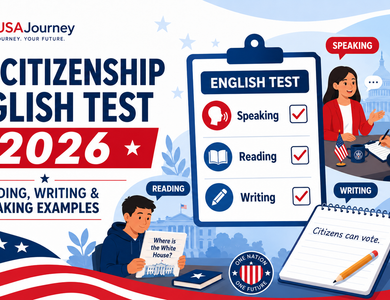
Speaking
Speaking ability is evaluated while the officer reviews Form N-400 and discusses eligibility. There is no separate set of ten speaking questions. The officer considers whether the applicant understands and responds meaningfully. Asking for a question to be repeated is not the same as failing, but an applicant cannot normally use an interpreter for the speaking test unless an exemption or accommodation applies.
Reading
The applicant must read one out of up to three sentences correctly. USCIS uses civic vocabulary. Minor accent or pronunciation issues do not necessarily cause failure when the meaning is conveyed. The officer stops once the applicant reads one sentence correctly.
Writing
The applicant must write one out of up to three sentences correctly. USCIS evaluates whether the sentence communicates the intended meaning. Capitalization, punctuation, and spelling matter to a practical degree, but limited errors may be acceptable when they do not prevent understanding.
Which civics test will be given?
The N-400 filing date determines the applicable civics-test version. Applicants whose N-400 was filed before October 20, 2025 generally take the 2008 test: up to 10 oral questions from a bank of 100, with six correct answers required. Applicants who filed on or after October 20, 2025 generally take the 2025 test: up to 20 oral questions from a bank of 128, with 12 correct answers required.
Applicants should study from the official materials for their version. Our detailed 2025 U.S. Civics Test guide explains the stop rules, filing-date rule, special 65/20 format, and how answers tied to current officeholders must be updated.
Can you correct Form N-400 answers at the interview?
Yes. The interview is designed in part to review and update the application. Common changes include a new address, trip, employer, child, marriage, separation, divorce, citation, arrest, or tax issue. Tell the officer about the change before affirming the answer. Bring the original or certified document that supports it when available.
A correction does not automatically mean denial. Its significance depends on what changed and whether the applicant remains eligible. A new two-week vacation is different from a year-long absence; correcting a typographical date is different from disclosing a previously hidden arrest. Material inconsistencies can lead to more questions, a request for evidence, continuance, denial, or examination of whether testimony was truthful.
What documents should you bring?
Follow the interview notice first because it is case-specific. USCIS generally instructs applicants to bring the appointment notice, Permanent Resident Card, state-issued identification, and all valid and expired passports and travel documents documenting absences since becoming a permanent resident.
- The Form N-400 interview appointment notice
- Permanent Resident Card, even if expired, plus evidence of an approved replacement or extension when relevant
- A government-issued photo ID
- All current and expired passports and travel documents
- A complete copy of the filed N-400 and every supporting document
- Certified civil documents for relevant marriages, divorces, deaths, name changes, or children
- Tax transcripts, payment-plan records, or proof of support when the case raises those issues
- Certified court and police records for disclosed incidents, including proof that every sentence was completed
- Evidence supporting any change or correction since filing
- Any document specifically requested in the appointment notice or a prior USCIS notice
Do not rely on this general list as a substitute for the current notice or case-specific legal advice. The next guide in this cluster will provide a dedicated naturalization document checklist organized by applicant profile.
How to answer questions without creating problems
- Tell the truth. The interview is under oath, and a false answer can be worse than the underlying fact.
- Listen to the entire question. Do not answer a familiar word while missing a date range or legal qualifier.
- Ask for repetition or clarification. Do not guess when the wording is not understood.
- Keep answers direct. Answer the question, then explain when an explanation is necessary.
- Correct mistakes promptly. State what was wrong, give the accurate answer, and provide evidence if available.
- Do not memorize false simplicity. “No” is not a safe answer merely because it is easier to pronounce.
- Do not argue about the civics test. Give one accepted answer; current names and offices can change.
- Pause when legal risk appears. An applicant may request legal representation and should not improvise through serious criminal, fraud, voting, citizenship-claim, or removal issues.
What if you do not pass a test or USCIS needs more evidence?
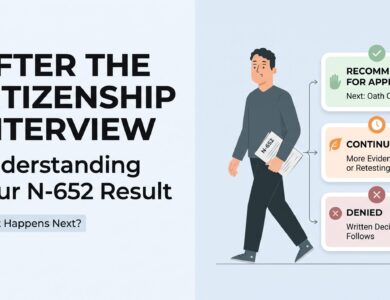
USCIS gives the applicant Form N-652, Naturalization Interview Results, at the end of the examination. The notice may state that the application is recommended for approval, continued, or unable to be decided at that time. A continued case may require additional evidence or a retest.
An applicant who fails part of the English or civics test at the first examination generally receives a second opportunity on the failed portion between 60 and 90 days after the initial examination. The applicant does not ordinarily retake a portion already passed. Failure at the reexamination can lead to denial. A request for evidence has its own deadline and must be answered completely and on time.
A practical preparation plan for the week before the interview
- Read the filed N-400 from beginning to end and mark every answer that needs an update.
- Build a one-page change list covering addresses, jobs, travel, family, taxes, citations, arrests, and organizations.
- Recalculate physical presence and confirm there was no new trip affecting eligibility.
- Arrange originals and certified records by N-400 section instead of carrying an unsorted folder.
- Practice answering personal questions in natural English without memorizing a false script.
- Practice the official reading and writing vocabulary and study the correct civics-test version.
- Check current answers involving elected officials shortly before the appointment.
- Review the appointment notice, route, security rules, and arrival time.
- Speak with an immigration attorney before the interview if any answer could expose criminal, fraud, removal, abandonment, voting, or false-citizenship issues.
Frequently asked questions
What questions are asked at the U.S. citizenship interview?
A USCIS officer reviews the applicant’s Form N-400 and asks case-specific questions about identity, residence, travel, family, work, taxes, arrests, organizations, and eligibility. Most applicants also take English and civics tests unless an exemption or waiver applies.
Do I need to memorize my entire N-400?
No. You should understand every answer and be able to explain your history accurately, but you do not need to recite the form word for word. Bring a complete copy and identify all changes since filing.
Can I change an answer on my N-400 during the interview?
Yes. Tell the officer about mistakes and changes before confirming the answer. Whether the correction affects approval depends on the underlying fact and whether you remain eligible.
Can I ask the USCIS officer to repeat a question?
Yes. Asking for repetition or clarification is better than guessing. Applicants who must satisfy the English requirement still need to demonstrate that they can understand and respond in ordinary English.
Is the citizenship speaking test a separate test?
No. USCIS evaluates speaking ability during the officer’s review of Form N-400 and the eligibility discussion. Reading and writing are administered as separate test components.
How many reading and writing sentences are on the naturalization test?
The officer gives up to three opportunities for reading and up to three for writing. The applicant must correctly read one sentence and correctly write one sentence.
Which civics test will I take in 2026?
The filing date controls. An N-400 filed before October 20, 2025 generally uses the 2008 test. An N-400 filed on or after that date generally uses the 2025 test.
Can I bring an interpreter to the citizenship interview?
Applicants who qualify for an English-language exemption may take the civics test in their language and must bring a qualified interpreter. Other applicants generally cannot use an interpreter to satisfy the English test, although disability accommodations and waivers may apply.
What happens if I fail the English or civics test?
USCIS generally retests only the failed portion between 60 and 90 days after the first examination. Failing the required portion again can result in denial.
Can a lawyer attend my naturalization interview?
Yes. An applicant may be represented by an authorized attorney or accredited representative, generally with Form G-28 properly filed. The representative cannot answer factual questions in place of the applicant.
Will USCIS ask about trips taken after filing Form N-400?
Yes. You must disclose travel after filing because continuous residence and physical presence must remain satisfied through the naturalization process.
When should I get legal help before the interview?
Seek case-specific legal advice for arrests or convictions, false citizenship claims, voting, removal history, long absences, tax inconsistencies, fraud concerns, Selective Service issues, or any material fact omitted from the N-400.
Official sources
- USCIS: The Naturalization Interview and Test
- USCIS Policy Manual, Volume 12, Part B, Chapter 3: Naturalization Interview
- USCIS Policy Manual, Volume 12, Part E, Chapter 2: English and Civics Testing
- USCIS: Citizenship, What to Expect
- USCIS: Exceptions and Accommodations