U.S. Citizenship English Test 2026: Reading, Writing & Speaking Practice

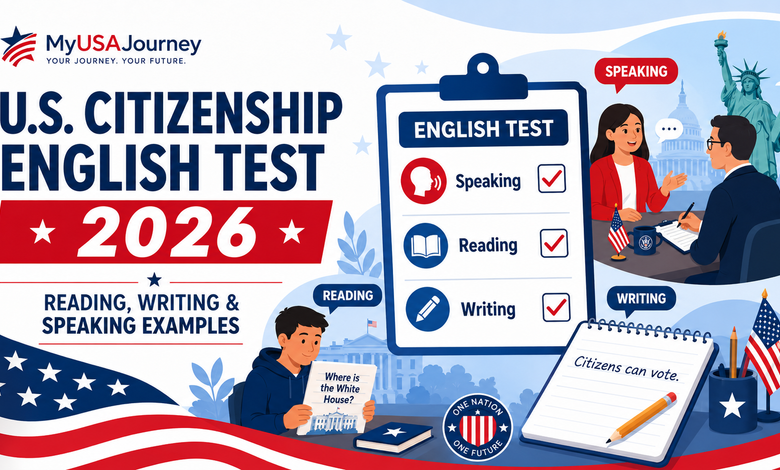
The English test for U.S. citizenship is not a separate school-style exam with grammar exercises and a final score. USCIS evaluates your English during the naturalization interview in three practical ways: speaking, reading, and writing.
For most Form N-400 applicants who do not qualify for an exception, the rules are straightforward. Your speaking and understanding are evaluated while the USCIS officer reviews your application with you. For reading, you must correctly read aloud one out of up to three sentences. For writing, you must correctly write one out of up to three dictated sentences.
Quick answer: you do not need perfect English, a perfect accent, or perfect spelling. USCIS is looking for basic English in ordinary usage. For reading and writing, the officer stops once you successfully complete one sentence. For speaking, the goal is to understand and respond to the questions asked during your N-400 eligibility interview.
Last verified: August 21, 2026. This guide is based on current USCIS naturalization-test materials and scoring guidance. Always follow your interview notice and check USCIS again before your appointment because procedures and study resources can be updated.
What is the U.S. citizenship English test in 2026?
The naturalization test has an English component and a civics component. The English portion checks whether you can understand, speak, read, and write basic English unless an exception applies.
| English skill | How USCIS tests it | What you need to do |
|---|---|---|
| Speaking and understanding | During the Form N-400 eligibility interview | Generally understand and respond to questions relevant to your application and eligibility |
| Reading | You read sentences aloud | Read 1 out of up to 3 sentences correctly |
| Writing | The officer dictates sentences | Write 1 out of up to 3 sentences correctly |
This English requirement is separate from the civics test. If you filed Form N-400 on or after October 20, 2025, you will generally take the 2025 civics test unless a special rule applies. That civics version uses a bank of 128 questions, with up to 20 asked and 12 correct answers required. You can practice that portion separately with our 20-question U.S. citizenship practice test.
Citizenship English test at a glance
- Speaking: there is no separate speech presentation. The officer evaluates your English as you answer questions about your Form N-400 and eligibility.
- Understanding: you should be able to follow the officer’s questions, directions, and prompts.
- Reading: you get up to three sentences and must read one correctly.
- Writing: you get up to three dictated sentences and must write one correctly.
- Accent: USCIS scoring guidance says an applicant should not fail the reading portion merely because of an accent.
- Minor writing errors: spelling, capitalization, punctuation, or grammar errors do not necessarily cause failure if they do not interfere with the meaning.
The English test is therefore more practical than many applicants expect. You are not asked to write an essay or explain advanced grammar rules. The most important preparation is understanding the language of your own N-400 interview and becoming comfortable with the limited vocabulary USCIS uses for the reading and writing portions.
Part 1: How the citizenship speaking test works
The speaking portion is often misunderstood because there is no moment when the officer announces, “Now we begin the speaking test.” USCIS evaluates your ability to speak English from your answers to questions normally asked during the eligibility interview.
The officer reviews Form N-400 for accuracy and asks about information relevant to your eligibility. This can include your identity, address history, employment, family, travel, immigration history, taxes, Selective Service where applicable, arrests or citations, and the yes/no eligibility questions on the application.
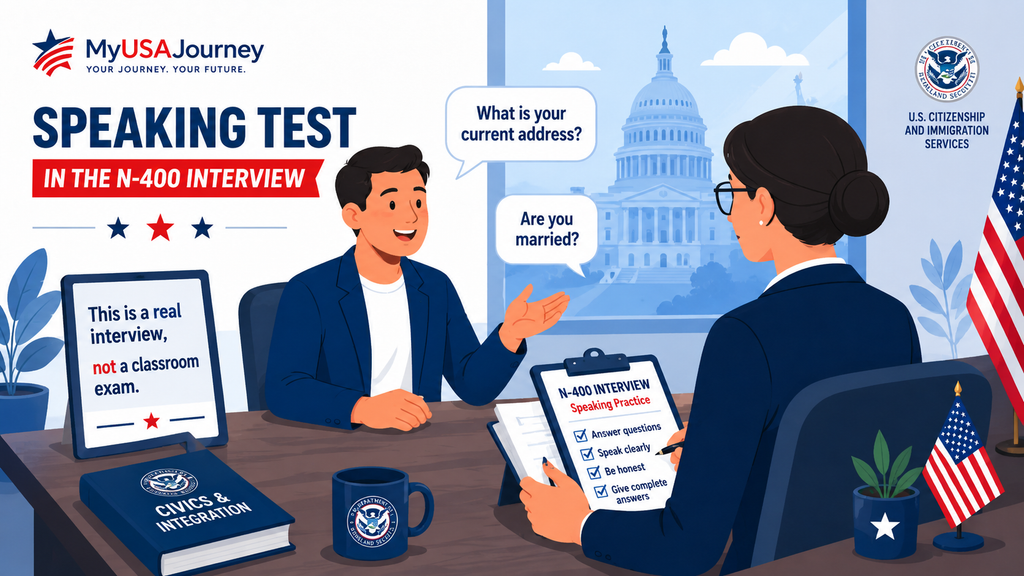
USCIS scoring guidance explains that officers may repeat or rephrase questions while determining whether the applicant understands English. If you generally understand and respond to questions relevant to the eligibility determination, simple words or phrases can be sufficient. You do not need to sound like a native speaker.
That does not mean you should memorize a script. Your interview is based on your Form N-400, and the officer can ask follow-up questions. The best speaking practice is to review your actual application and explain your own answers naturally.
Speaking practice: questions you should be ready to understand
The exact wording and follow-up questions vary by case, but these original practice prompts reflect the kinds of personal topics that can arise during an N-400 review:
- What is your current home address?
- How long have you lived there?
- Where did you live before that?
- Where do you work now?
- When did you start working there?
- Are you married?
- How many children do you have?
- When was your most recent trip outside the United States?
- How long were you outside the country?
- Have you moved since you filed your N-400?
- Have you taken any trips since filing?
- Has anything on your application changed?
Do not invent answers to practice these. Open your own application and answer with your real facts. Our U.S. citizenship interview questions guide goes deeper into the N-400 review, civics test, document questions, and interview-day flow.
Can you ask the USCIS officer to repeat a question?
Yes. Not hearing or understanding a question the first time does not automatically mean you failed the English requirement. USCIS scoring guidance instructs officers to repeat and rephrase questions while determining whether an applicant understands English.
Use simple, natural phrases such as “Could you please repeat the question?”, “Could you please say that again?”, or “I’m sorry, I didn’t understand the last part.” There is an important difference between occasionally asking for clarification and being unable to understand the interview even after questions are repeated or rephrased.
Part 2: How the citizenship reading test works
For the reading portion, USCIS gives you no more than three sentences. You must read one sentence aloud correctly. Once you successfully read one sentence, the officer stops the reading test.
The sentences use vocabulary published by USCIS and focus largely on U.S. civics and history. The official reading vocabulary includes categories such as people, civics terms, places, holidays, question words, verbs, and common function words.
What counts as passing the reading test?
According to USCIS scoring guidance, a successful reading response generally communicates the sentence without errors that interfere with meaning. An applicant may still pass with pronunciation or intonation errors that do not change the meaning. Short words may sometimes be omitted if the omission does not interfere with meaning.
You do not need to answer the question that you read. If the sentence is a question, your task in the reading portion is to read it aloud, not to solve it.
What can cause a reading failure?
USCIS can mark a sentence incorrect when the applicant does not read it, leaves out an important content word, substitutes another content word, pauses for extended periods, or makes pronunciation errors that prevent the officer from understanding the meaning. Focus first on the important words in each sentence. Perfect pronunciation is less important than clear meaning.
Citizenship reading test practice: 15 sample sentences
These are original practice sentences built around the type of basic civics vocabulary found in USCIS study materials. They are not a promise of the exact sentences you will receive at your interview.
- Who was George Washington?
- Where does the President live?
- What does Congress do?
- How many senators are there?
- When is Independence Day?
- Where is the White House?
- Who can vote in the United States?
- What is one right of a citizen?
- Where is the capital of the United States?
- What colors are on the American flag?
- When is Thanksgiving?
- Who elects Congress?
- Where do senators meet?
- What country is north of the United States?
- Who was Abraham Lincoln?
Practice each sentence out loud. Do not whisper. Your goal is to become comfortable recognizing familiar words and reading at a normal pace without long pauses.
Part 3: How the citizenship writing test works
For the writing portion, the officer dictates a sentence and you write it. USCIS administers no more than three writing sentences, and you must correctly write one of them. The officer stops once you have successfully written a sentence.
The official writing vocabulary also focuses on basic civics and history. This means your study should not be random. Learn the USCIS vocabulary, but practice it in complete dictated sentences so that listening and writing become connected.
Do spelling mistakes make you fail?
Not necessarily. USCIS scoring guidance says spelling, capitalization, punctuation, and grammatical errors do not automatically cause failure when the written sentence keeps the same general meaning and remains understandable. You should still practice standard spelling because enough mistakes can eventually interfere with meaning.
Can you use abbreviations or numbers?
USCIS scoring guidance says an applicant should not abbreviate dictated words. Numbers, however, may be written as numerals or spelled out. If the officer dictates a full word, practice writing the full word rather than replacing it with a shortcut.
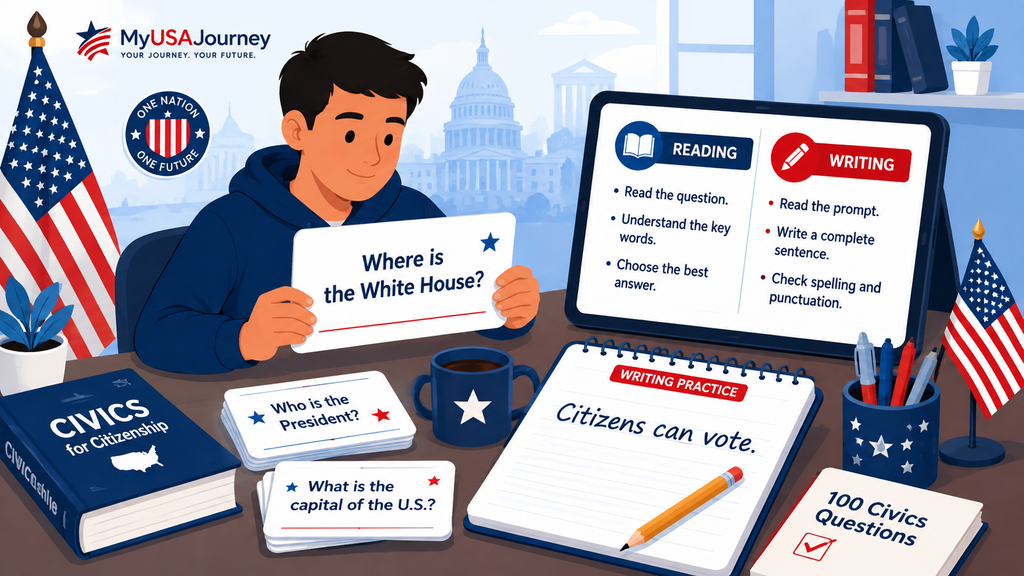
Citizenship writing test practice: 15 dictation sentences
For realistic practice, do not copy these sentences while looking at them. Ask another person to read each sentence aloud, or record yourself reading them and play the recording later. Then write what you hear.
- Citizens can vote.
- The President lives in the White House.
- Congress meets in Washington, D.C.
- We pay taxes.
- The United States has fifty states.
- George Washington was the first President.
- Abraham Lincoln was President during the Civil War.
- Citizens have the right to vote.
- The American flag is red, white, and blue.
- Independence Day is in July.
- Senators meet in Congress.
- Washington, D.C. is the capital.
- People vote for the President.
- Freedom of speech is a right.
- Thanksgiving is in November.
These sentences are practice material, not an official list of future test sentences. For the vocabulary USCIS actually uses, download the official reading and writing vocabulary materials linked in the sources section below.
The best way to practice reading and writing together
- Learn 10 to 15 words at a time. Say each word aloud and make sure you understand it.
- Read short sentences aloud. Focus on the civics content words first.
- Turn the same vocabulary into dictation. Have someone read a sentence while you write it without looking.
- Check meaning, not just spelling. Ask whether your written sentence still communicates what was dictated.
- Repeat mistakes later. Do not simply rewrite a missed word five times in a row; come back to it after other practice.
USCIS publishes reading vocabulary flash cards and writing vocabulary materials. Use those official resources as your master vocabulary source rather than relying only on social-media videos or old unofficial lists.
How to prepare for the speaking test with your own N-400
The biggest mistake in speaking preparation is studying generic English while ignoring the application the officer will actually review. Your N-400 is one of your most useful study tools.
Step 1: Review personal-information sections
Practice saying your full legal name, date of birth, address, work history, marital information, children’s information where applicable, and travel history. Know the dates and facts you entered on the form.
Step 2: Practice the yes/no eligibility vocabulary
The naturalization application contains important legal and eligibility questions. Do not memorize “yes” or “no” mechanically. Understand what your own answer means and be prepared for a follow-up question when necessary.
If a question concerns arrests, taxes, immigration violations, false claims to citizenship, voting, Selective Service, or another potentially serious issue, language practice is not a substitute for legal advice. Make sure the substantive answer is accurate before practicing how to explain it.
Step 3: Practice changes since filing
Your life may change after you submit Form N-400. Practice explaining a new address, new job, recent trip, marriage-status change, citation, or other relevant update truthfully if something changed after filing.
Before the interview, use our naturalization documents checklist to organize what you may need to bring, and review your copy of the N-400 so that your spoken answers match your actual history.
Do you need perfect grammar to pass the citizenship English test?
No. USCIS is not evaluating you as an advanced English student. The legal standard concerns an understanding of English and the ability to read, write, and speak words in ordinary usage.
For speaking, USCIS guidance focuses on whether you generally understand and respond to relevant interview questions. Simple words or phrases may be enough. For reading, pronunciation or intonation errors can be acceptable when they do not interfere with meaning. For writing, some grammar, spelling, capitalization, or punctuation errors can be acceptable when the sentence remains understandable.
That is reassuring, but do not confuse “perfect English is not required” with “English does not matter.” If the officer cannot determine that you understand the questions or if your reading or writing does not communicate the sentence, you can fail that portion.
Who does not have to take the English test?
Some applicants qualify for an exception to the English requirement because of age and time as a lawful permanent resident. These rules are measured at the time of filing Form N-400.
| Rule | Age | Time as lawful permanent resident | English requirement | Civics |
|---|---|---|---|---|
| 50/20 | 50 or older | At least 20 years | Exempt | Still required; may generally take it in a language of choice |
| 55/15 | 55 or older | At least 15 years | Exempt | Still required; may generally take it in a language of choice |
| 65/20 | 65 or older | At least 20 years | Exempt | Special consideration with designated civics questions |
Applicants using an age-and-residency English exception generally need an interpreter when taking the civics test in another language. The details matter, so read our dedicated 50/20, 55/15 and 65/20 naturalization test exceptions guide before relying on an exception.
What about Form N-648 and disability exceptions?
A separate medical disability exception may apply when a qualifying physical or developmental disability or mental impairment prevents an applicant from meeting the English requirement, the civics requirement, or both. This is different from simply finding English difficult to learn.
The request uses Form N-648, Medical Certification for Disability Exceptions, completed by an authorized medical professional. USCIS evaluates whether the form adequately explains the connection between the medically determinable impairment and the applicant’s inability to meet the relevant naturalization educational requirement.
Do not assume that an accommodation and an exception are the same thing. An accommodation changes how USCIS provides access to the process, while a qualifying N-648 can create an exception to an English or civics requirement. Check the current USCIS instructions for your situation.
What happens if you fail English but pass civics?
USCIS generally provides two opportunities to meet the naturalization testing requirements on one N-400 application. If you fail a portion at the initial examination, USCIS generally schedules a reexamination between 60 and 90 days later and retests the portion you failed.
For example, if you pass civics but fail writing, you generally do not start the entire naturalization test from zero at the reexamination. USCIS retests the failed requirement. Your actual notice controls, so read every instruction USCIS gives you.
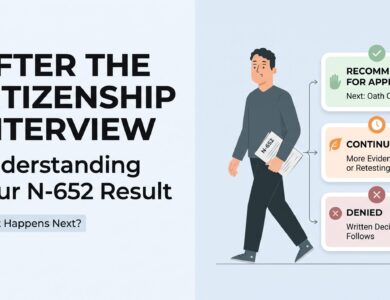
If you have already completed the interview, our Form N-652 citizenship interview results guide explains common outcomes, continuations, and what may happen after testing.
7-day citizenship English test study plan
| Day | Main focus | Practice |
|---|---|---|
| Day 1 | Your Form N-400 | Read your application and answer basic personal questions aloud. |
| Day 2 | Reading vocabulary | Study official vocabulary in small groups and read short sentences aloud. |
| Day 3 | Writing vocabulary | Write short civics sentences from dictation without looking. |
| Day 4 | N-400 speaking | Practice address, work, family, travel, and changes since filing. |
| Day 5 | Reading simulation | Run sets of up to three sentences and stop after one clear success. |
| Day 6 | Writing simulation | Run dictated sets of up to three sentences and review errors afterward. |
| Day 7 | Full interview practice | Combine N-400 questions, reading, writing, and civics in one mock session. |
If your English is still developing, use a longer schedule. The goal is not to cram vocabulary for one evening. You want the interview language to feel familiar enough that you can listen, understand, and answer while also managing normal interview stress.
Common English-test mistakes to avoid
- Preparing only for civics. Knowing all 128 civics answers does not automatically satisfy the English requirement.
- Memorizing generic interview scripts. The officer is reviewing your real application and can ask follow-up questions.
- Reading silently. The reading test is oral, so practice out loud.
- Copying instead of practicing dictation. The writing task tests whether you can write what the officer says.
- Panicking over an accent. Clear meaning matters more than sounding native.
- Trying to use abbreviations in writing. Practice writing dictated words in full.
- Ignoring your post-filing changes. Be ready to explain truthful updates to your N-400.
- Assuming an exemption without checking the requirements. Age alone does not create the 50/20 or 55/15 exception.
English test vs. civics test: do not mix them up
| Test | What it measures | Typical format |
|---|---|---|
| English speaking | Basic ability to speak and understand English | Evaluated through the N-400 eligibility interview |
| English reading | Basic reading in ordinary English | Read 1 of up to 3 sentences correctly |
| English writing | Basic written English | Write 1 of up to 3 dictated sentences correctly |
| Civics | Knowledge of U.S. history and government | Oral questions; format depends on which civics version applies |
If you are preparing for the complete process, start with our U.S. citizenship through naturalization guide. It connects eligibility, Form N-400, the English and civics tests, the interview, decision, and Oath of Allegiance.
Final practice checklist before your USCIS interview
- Review a complete copy of your Form N-400.
- Practice answering personal N-400 questions aloud in English.
- Practice asking politely for repetition when necessary.
- Study the official USCIS reading vocabulary.
- Read sample sentences aloud at a normal pace.
- Study the official USCIS writing vocabulary.
- Practice writing sentences from dictation.
- Do not obsess over minor errors that do not change meaning.
- Prepare separately for the civics test version that applies to you.
- Confirm whether any English exception or disability exception actually applies before relying on it.
Most importantly, prepare for the English portion as part of a real conversation, not as a worksheet. The officer needs to see that you can understand and communicate basic information relevant to your naturalization case. Daily oral practice with your own N-400 is often more valuable than memorizing complicated grammar rules.
Official USCIS sources
- USCIS — The Naturalization Interview and Test
- USCIS — Scoring Guidelines for the U.S. Naturalization Test
- USCIS — Components of the Naturalization Test
- USCIS — Reading Vocabulary for the Naturalization Test
- USCIS — Writing Vocabulary for the Naturalization Test
- USCIS — Exceptions and Accommodations
- USCIS — Form N-648, Medical Certification for Disability Exceptions
FAQ: U.S. Citizenship English Test 2026
What are the three parts of the citizenship English test?
USCIS evaluates speaking, reading, and writing. Speaking and understanding are evaluated during the Form N-400 eligibility interview. You must also read one out of up to three sentences correctly and write one out of up to three dictated sentences correctly.
How many sentences do I have to read correctly?
You must read one sentence correctly out of up to three sentences. Once you successfully read one sentence, the USCIS officer stops the reading portion.
How many sentences do I have to write correctly?
You must write one dictated sentence correctly out of up to three sentences. Once you successfully write one sentence, the officer stops the writing portion.
Can I fail the citizenship test because of my accent?
USCIS scoring guidance says an applicant should not fail the reading portion merely because of an accent. Pronunciation or intonation errors can be acceptable if they do not interfere with the meaning.
Do spelling mistakes automatically fail the writing test?
No. USCIS guidance allows some spelling, grammar, capitalization, and punctuation errors if they do not interfere with the meaning of the dictated sentence.
Is there a separate speaking exam for U.S. citizenship?
There is no separate speech presentation. USCIS evaluates your ability to speak and understand English through your answers during the Form N-400 eligibility interview.
Can I ask the USCIS officer to repeat a question?
Yes. USCIS scoring guidance provides for officers to repeat and rephrase questions while determining whether an applicant understands English. Repeated inability to understand relevant questions can still affect the speaking and understanding assessment.
Who is exempt from the citizenship English test?
The 50/20 and 55/15 rules exempt qualifying applicants from the English requirement based on age and years as a lawful permanent resident. The 65/20 rule also includes special civics consideration. A separate disability exception may be available through a qualifying Form N-648.
What happens if I pass civics but fail English?
USCIS generally provides a second opportunity to pass a failed testing requirement and schedules reexamination 60 to 90 days after the initial examination. USCIS generally retests the portion that was failed.
Does the 2025 civics test change the English reading and writing test?
The 2025 civics test changes the civics component for applicants to whom it applies. The English requirement remains a separate component covering speaking, reading, and writing unless an exception applies.