U.S. Citizenship Test Practice 2026: 20 Questions With Answers

If you are preparing for the U.S. citizenship test in 2026, the most useful practice is not a multiple-choice quiz: it is answering civics questions out loud, without seeing possible answers. That is how USCIS administers the civics portion of the naturalization test.
This 20-question U.S. citizenship practice test is designed around the 2025 Naturalization Civics Test, which is the version USCIS generally gives to applicants who filed Form N-400 on or after October 20, 2025. The official study bank contains 128 questions. During the real interview, a USCIS officer asks up to 20 questions and you must answer at least 12 correctly to pass the civics portion.
Practice rule: read each question once, answer out loud, and do not look at the answer key until you finish. To imitate the real 2025 civics test, stop as soon as you reach 12 correct answers or 9 incorrect answers. The real test is oral, not multiple choice.
Last verified: August 20, 2026. USCIS can update answers that depend on elections, appointments, or where you live. Always check the official USCIS materials again shortly before your interview.
Which U.S. citizenship test applies to you in 2026?
The year of your interview does not determine which civics test you take. The key date is when you filed your Form N-400, Application for Naturalization.
| Form N-400 filing date | Civics test version | Study bank | Questions asked | Correct answers needed |
|---|---|---|---|---|
| Before October 20, 2025 | 2008 civics test | 100 questions | Up to 10 | 6 |
| On or after October 20, 2025 | 2025 civics test | 128 questions | Up to 20 | 12 |
USCIS announced the 2025 Naturalization Civics Test in September 2025 and applies it to naturalization applications filed on or after October 20, 2025. For most people filing in 2026, that means the 128-question version is the one to study.
If you need the full rules before practicing, read our 2025 U.S. Civics Test guide. It explains the 128-question bank, the 12-out-of-20 passing rule, the older 2008 test, changing answers, and special testing rules.
How the real citizenship civics test works
The civics test happens during your naturalization interview. A USCIS officer asks the questions orally. You answer orally. There are no A, B, C, or D choices on the real civics test.
- The standard 2025 civics question bank contains 128 questions.
- The officer asks up to 20 questions.
- You pass after 12 correct answers.
- You fail that attempt after 9 incorrect answers, because you can no longer reach 12 correct within 20 questions.
- The officer stops once you have clearly passed or failed.
- Some official questions have more than one accepted answer. Give only the number of answers the question requests.
The civics test is only one part of the appointment. Unless an exception applies, USCIS also evaluates your English and reviews your Form N-400. Our U.S. citizenship interview questions guide explains how the N-400 review and test fit together.
U.S. Citizenship Test Practice 2026: 20 Questions
Use this section as a mock interview. Do not scroll to the answer key until you have answered the questions aloud. Keep a simple score on paper: one point for each correct answer.
Practice questions
- What is the supreme law of the land?
- How many amendments does the U.S. Constitution have?
- What is the economic system of the United States?
- Name the three branches of government.
- What part of the federal government writes laws?
- What are the two parts of the U.S. Congress?
- How many U.S. senators are there?
- The President of the United States is elected for how many years?
- What is the highest court in the United States?
- Name one power that is only for the federal government.
- Who can vote in federal elections, run for federal office, and serve on a jury in the United States?
- What do we show loyalty to when we say the Pledge of Allegiance?
- Name one way Americans can serve their country.
- Who lived in America before the Europeans arrived?
- What war did the Americans fight to win independence from Britain?
- Who wrote the Declaration of Independence?
- When was the Declaration of Independence adopted?
- Name the U.S. war between the North and the South.
- What did the Emancipation Proclamation do?
- What did the civil rights movement do?
Stop and score yourself before reading further. If you reached 12 correct answers before 9 incorrect answers, you would meet the civics passing threshold in this practice simulation. That does not guarantee a pass at USCIS because the officer can select different questions from the full official bank.
Answer key for the 20-question citizenship practice test
The answers below use concise responses accepted in the official civics materials. Some questions have additional acceptable answers. When USCIS asks for one example, one correct example is enough. When a question asks for more than one answer, give the required number.
| # | Short accepted answer | What to remember |
|---|---|---|
| 1 | The U.S. Constitution | The Constitution is the supreme law of the land. |
| 2 | 27 | The Constitution currently has twenty-seven amendments. |
| 3 | Capitalism / free market economy | Either concise accepted response is enough. |
| 4 | Legislative, executive, and judicial | You can also connect them with Congress, the President, and the courts. |
| 5 | Congress / the legislative branch | Congress writes federal laws. |
| 6 | The Senate and the House of Representatives | These are the two chambers of Congress. |
| 7 | 100 | Each state has two senators. |
| 8 | 4 years | A presidential term lasts four years. |
| 9 | The Supreme Court | It is the highest court in the United States. |
| 10 | For example: declare war | Other accepted examples include making treaties, setting foreign policy, creating an army, or printing/minting money. |
| 11 | U.S. citizens | The question is about federal voting, federal office, and jury service. |
| 12 | The United States / the flag | Either response is listed in the official material. |
| 13 | For example: vote | Other accepted examples include paying taxes, obeying the law, serving in the military, running for office, or government service. |
| 14 | American Indians / Native Americans | Either term is accepted in the official civics material. |
| 15 | The American Revolution / Revolutionary War | The war for American independence from Britain. |
| 16 | Thomas Jefferson | Jefferson is the accepted short answer. |
| 17 | July 4, 1776 | Know the full date. |
| 18 | The Civil War | The U.S. war between the North and the South. |
| 19 | It freed the slaves | USCIS also accepts more specific formulations referring to enslaved people in the Confederacy or Confederate states. |
| 20 | It fought to end racial discrimination | Keep the answer direct and clear. |
How to interpret your practice score
| Practice result | What it suggests | What to do next |
|---|---|---|
| 18-20 correct | Strong performance on this set | Switch to random practice across all 128 questions and verify changing answers. |
| 15-17 correct | Good foundation | Identify weak topics and practice oral recall without answer choices. |
| 12-14 correct | At or just above the official threshold | Do not stop studying. Build a larger safety margin before the interview. |
| 0-11 correct | Below the standard passing threshold on this set | Return to the official USCIS question bank and study by topic before retesting yourself. |
A score of 12 out of 20 is enough to pass the standard 2025 civics test, but it is a poor study target. On interview day you may be nervous, mishear a question, forget an answer you knew the night before, or receive a group of questions that happens to match your weaker topics. Aim to score consistently well above 12 during random practice.
Why multiple-choice practice can give you false confidence
Many citizenship apps and websites use multiple-choice questions because they are fast and convenient. They can be useful for early learning, but they make the task easier than the real interview. Recognizing the correct answer among four choices is not the same as producing the answer from memory.
For example, seeing “27” next to three obviously wrong numbers may feel easy. Hearing “How many amendments does the U.S. Constitution have?” and answering immediately without prompts is a different skill. Your final preparation should therefore be oral and open-ended.
- Read or hear the question once.
- Answer aloud before looking at anything.
- Mark the question wrong if you needed a clue.
- Repeat missed questions later in a different order.
- Practice complete 20-question simulations using the real stopping rule.
The 128 questions you really need to study
This page gives you one realistic 20-question practice set. It is not a replacement for the full USCIS bank. If the 2025 civics test applies to you, USCIS can select questions from all 128 official questions.
Download the official 2025 Civics Test: 128 Questions and Answers and use it as your master list. Our complete 2025 civics test guide explains how that bank is organized and how the test differs from the 2008 version.
Watch out for answers that can change
Some civics answers are not permanent. Questions involving elected officials, appointed officials, your state, or your congressional district can change. USCIS expects the answer that is correct at the time of your naturalization interview.
Examples include the President, Vice President, Speaker of the House, one of your state’s U.S. senators, your U.S. representative, your governor, and your state capital. Do not rely on an old video, screenshot, flash card, or PDF saved months earlier without checking it again.
Before your interview, use the official USCIS test updates page. For location-specific answers, make sure you know your current state and congressional district.
A simple 14-day citizenship test study plan
If you already have basic knowledge of U.S. civics, a two-week review schedule can organize your final preparation. If you are starting from zero or still developing English comprehension, give yourself more time.
| Days | Focus | Practice |
|---|---|---|
| 1-2 | Constitution, founding documents, principles of government | Answer short questions aloud until recall is automatic. |
| 3-4 | Congress, President, courts, federal and state powers | Draw the three branches and explain each role. |
| 5-6 | Rights, responsibilities, elections and civic participation | Practice questions that accept several examples. |
| 7-8 | Colonial history, independence, Constitution | Build a simple timeline with major dates and people. |
| 9-10 | Civil War, 1900s, civil rights, geography, symbols and holidays | Mix history and civics instead of studying in fixed order. |
| 11-12 | Your weak questions + changing answers | Repeat missed questions and verify current officials. |
| 13 | Full random simulations | Run several sets of up to 20 questions; stop at 12 correct or 9 wrong. |
| 14 | Light review | Review your weak list, organize interview documents, and avoid exhausting last-minute cramming. |
Do you also have to pass an English test?
Usually, yes. Civics and English are separate naturalization requirements. Unless an exception applies, USCIS evaluates three English components during the naturalization process.
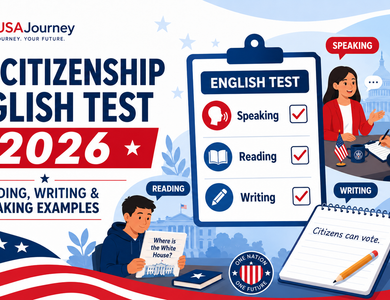
- Speaking: the officer evaluates your ability to speak and understand English through your answers during the N-400 interview.
- Reading: you must read one out of up to three sentences correctly.
- Writing: you must write one out of up to three sentences correctly.
Passing the civics test does not cancel a failed English portion, and passing English does not cancel a failed civics portion. Applicants who qualify for age-and-residency exceptions or a disability exception may follow different rules. Our 50/20, 55/15 and 65/20 naturalization test exceptions guide explains the main exceptions and the role of Form N-648.
What is the 65/20 special consideration?
If you are at least 65 years old and have been a lawful permanent resident for at least 20 years when you file Form N-400, USCIS provides special consideration for the civics test. A qualifying applicant studies a specially marked group of 20 questions. The officer asks up to 10 of those questions, and 6 correct answers are needed to pass.
A qualifying 65/20 applicant may also take the civics test in the language of choice and should follow the current USCIS instructions regarding an interpreter. Do not use the 20-question practice test on this page as your only study material if the 65/20 rule applies to you; use the specially designated USCIS questions.
What happens if you fail the citizenship test?
USCIS generally gives an applicant two opportunities to satisfy the English and civics testing requirements for one Form N-400 application. If you fail a portion at the first examination, USCIS generally schedules a reexamination between 60 and 90 days later and retests the portion you failed.
For example, if you pass English but fail civics, the second examination generally focuses on civics. If you fail the required portion again, USCIS can deny the naturalization application. Read the notice USCIS gives you because your actual appointment instructions control.
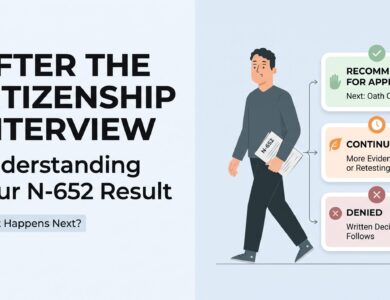
If you have already attended the interview, our guide to Form N-652 and citizenship interview results explains what “passed,” “continued,” retesting, and other post-interview outcomes can mean.
Common mistakes to avoid before the test
- Studying the wrong test version. Use your N-400 filing date, not simply the year of your interview.
- Practicing only multiple choice. The real civics test is oral.
- Memorizing only 20 favorite questions. Most 2025-test applicants must prepare the full 128-question bank.
- Using outdated political answers. Verify current officeholders shortly before the interview.
- Giving too many answers. If USCIS asks for one example, one clear accepted answer is enough.
- Ignoring the English test and N-400 review. The interview is broader than civics.
- Aiming for exactly 12 out of 20 in practice. Build a safety margin.
How to practice like a real USCIS interview
The most effective final-stage practice is simple: have another person ask you random questions from the official bank and answer immediately out loud. If you study alone, record the questions or use audio study materials so you are reacting to a spoken question instead of reading from the page.
- Shuffle questions from the full applicable USCIS bank.
- Ask each question once at a normal speaking pace.
- Allow yourself to ask for repetition if you genuinely did not hear it.
- Answer with the shortest complete accepted response.
- Do not award yourself a point if you needed to see a clue.
- For the standard 2025 test, stop at 12 correct or 9 incorrect.
- Write down every missed question and review it later.
When you can repeatedly pass random oral simulations with room to spare, your preparation is much closer to the real task USCIS will ask you to perform.
Before your citizenship interview: final checklist
- Confirm whether the 2008 or 2025 civics test applies to your N-400 filing date.
- Study the complete official question bank for your version.
- Practice answering aloud without multiple-choice prompts.
- Verify answers that depend on current officials or your location.
- Review the English reading and writing vocabulary if the English requirement applies to you.
- Review your own Form N-400 before the appointment.
- Bring the documents listed on your USCIS interview notice.
- If an exception may apply, verify the 50/20, 55/15, 65/20, or Form N-648 rules before the interview.
For the complete naturalization process—from eligibility and Form N-400 through the test, interview, decision, and oath—see our U.S. Citizenship Through Naturalization guide.
Official sources
- USCIS — 2025 Civics Test
- USCIS — 128 Civics Questions and Answers (2025 version)
- USCIS — Check for Test Updates
- USCIS — The Naturalization Interview and Test
- Federal Register — Notice of Implementation of 2025 Naturalization Civics Test
FAQ: U.S. Citizenship Test Practice 2026
How many questions are on the U.S. citizenship test in 2026?
For most applicants taking the 2025 civics test, the official bank contains 128 questions and the USCIS officer asks up to 20. You must answer 12 correctly to pass the civics portion.
Do I need 12 out of 20 correct to pass?
Yes, for the standard 2025 Naturalization Civics Test. USCIS stops after you reach 12 correct answers or 9 incorrect answers. Different rules apply to qualifying 65/20 applicants.
Is the U.S. citizenship test multiple choice?
No. The civics test is oral. A USCIS officer asks the questions aloud and you answer aloud without a list of answer choices.
Which civics test applies if my interview is in 2026?
The interview year does not decide the version. Applicants who filed Form N-400 before October 20, 2025 generally take the 2008 test. Applicants who filed on or after October 20, 2025 generally take the 2025 test.
Are there 100 or 128 citizenship questions?
Both lists can still matter. The 2008 test uses a 100-question study bank, while the 2025 test uses 128 questions. Your N-400 filing date determines which version generally applies.
Can the answers to citizenship questions change?
Yes. Answers involving elected or appointed officials and location-specific questions can change. USCIS expects the answer that is correct at the time of your interview.
What happens if I fail the civics test the first time?
USCIS generally gives you a second opportunity and retests the portion you failed between 60 and 90 days after the initial examination. Follow the appointment notice USCIS sends you.
Do I also need to take an English test?
Most applicants do. Unless an exception applies, USCIS evaluates speaking during the N-400 interview and requires you to read one out of up to three sentences and write one out of up to three sentences correctly.
What is the 65/20 citizenship test rule?
Applicants who are at least 65 and have been lawful permanent residents for at least 20 years at filing may receive special consideration. They study 20 specially marked civics questions and are asked up to 10, with 6 correct answers needed to pass.
Is this 20-question practice test enough to study for USCIS?
No. It is a realistic practice set, not the complete question bank. If the 2025 civics test applies to you, study all 128 official USCIS questions and use random oral practice before the interview.