EB-2 NIW Cost 2026: USCIS Fees, Premium Processing & Total Budget

How much does an EB-2 NIW case actually cost in 2026? The answer depends on whether you use premium processing, whether you adjust status inside the United States or use consular processing abroad, and whether family members immigrate with you.
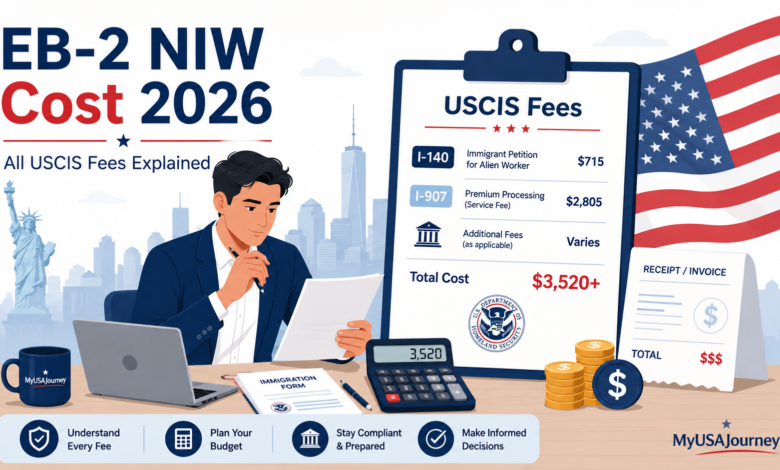
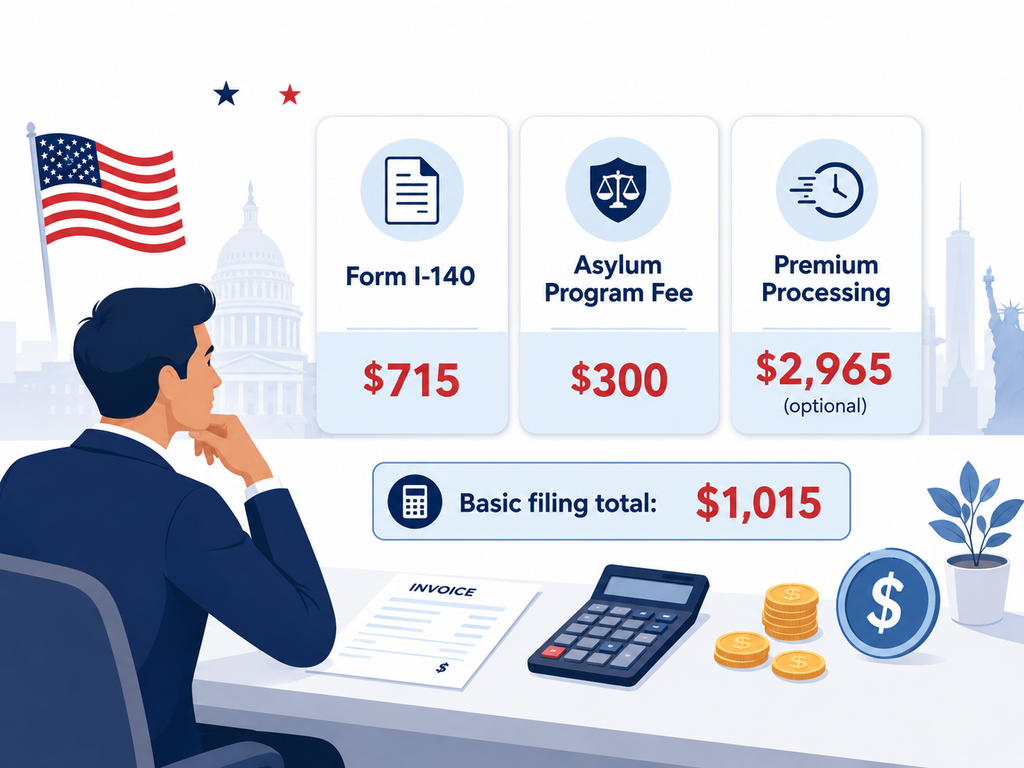
For a self-petitioned EB-2 NIW Form I-140 filed in 2026, the core USCIS government filing cost is generally $1,015: a $715 Form I-140 filing fee plus the $300 Asylum Program Fee applicable to a self-petitioner. If you add premium processing for a request postmarked on or after March 1, 2026, the optional Form I-907 fee is $2,965, bringing the I-140-stage government total to $3,980.
Quick answer: budget at least $1,015 in government fees for a basic self-petitioned NIW I-140, or $3,980 with premium processing. The full Green Card process costs more because adjustment of status or consular processing comes later and has separate fees for each applicant.
Last verified: August 26, 2026. USCIS fees can change, and incorrect payments can cause rejection. Always verify the current Form G-1055 Fee Schedule and filing instructions immediately before submission.
EB-2 NIW cost in 2026: all major government fees
| Stage / item | 2026 fee | When it applies |
|---|---|---|
| Form I-140 | $715 | Required for the NIW petition |
| Asylum Program Fee — self-petitioner | $300 | Typical NIW self-petitioner |
| Form I-907 premium processing | $2,965 | Optional |
| Form I-485, age 14+ | $1,440 | Adjustment of status in the U.S. |
| Form I-485, child under 14 filing with parent | $950 | If applicable |
| I-765 tied to qualifying pending I-485 | $260 | Optional employment authorization |
| I-131 advance parole | $630 paper / $580 online where eligible | Optional travel document |
| Employment-based immigrant visa application | $345 per person | Consular processing |
| USCIS Immigrant Fee | $235 per person | Generally after immigrant visa issuance |
If you are still evaluating eligibility rather than cost, start with our EB-2 NIW Requirements 2026 guide.
Why the basic EB-2 NIW filing costs $1,015, not $715
The Form I-140 filing fee is $715. But Form I-140 petitioners may also owe an Asylum Program Fee. The current USCIS fee schedule lists $600 for a regular petitioner, $0 for a qualifying nonprofit, and $300 for a small employer or self-petitioner.
- Form I-140: $715
- Asylum Program Fee for a typical NIW self-petitioner: $300
- Total: $1,015
Do not assume the Asylum Program Fee is irrelevant because your petition has nothing to do with seeking asylum. It is a funding fee imposed on certain employment-based petitions, including Form I-140.
How much is EB-2 NIW premium processing in 2026?
For eligible premium-processing requests postmarked on or after March 1, 2026, the Form I-907 fee for Form I-140 categories including E21 NIW is $2,965. The fee increased from $2,805 through the statutory biennial inflation adjustment.
| Option | I-140-stage government total |
|---|---|
| Regular processing | $715 + $300 = $1,015 |
| Premium processing | $1,015 + $2,965 = $3,980 |
Premium processing changes the speed of USCIS action on the I-140; it does not strengthen eligibility or move the Visa Bulletin. See our EB-2 NIW premium processing guide for the 45-business-day rule.
Budget scenario 1: single applicant, regular processing
| Item | Cost |
|---|---|
| I-140 | $715 |
| Self-petitioner Asylum Program Fee | $300 |
| Immediate government total | $1,015 |
This is only the petition stage. It excludes legal help, credential evaluations, translations, expert evidence, shipping, and the later permanent-residence stage.
Budget scenario 2: single applicant with premium processing
| Item | Cost |
|---|---|
| I-140 | $715 |
| Self-petitioner Asylum Program Fee | $300 |
| I-907 premium processing | $2,965 |
| Immediate government total | $3,980 |
Budget scenario 3: NIW plus adjustment of status
If visa availability and USCIS filing-chart rules permit Form I-485, an applicant age 14 or older generally pays a $1,440 I-485 fee. That produces the following principal-applicant government subtotal:
| Item | Regular NIW | Premium NIW |
|---|---|---|
| I-140 + self-petitioner fee | $1,015 | $1,015 |
| Premium processing | $0 | $2,965 |
| I-485 | $1,440 | $1,440 |
| Subtotal | $2,455 | $5,420 |
Those totals exclude optional employment authorization, advance parole, medical examination, and derivative family applications.
Are the work permit and advance parole free with I-485?
No. Under the current fee structure, Forms I-765 and I-131 are not automatically bundled for free with a newly filed I-485. For an applicant whose I-485 was filed with the required fee on or after April 1, 2024 and remains pending, the current I-765 fee is $260. For advance parole based on a pending I-485, the fee schedule lists $630 for paper filing and $580 online where the filing category and USCIS system allow online filing.
How much does an EB-2 NIW family case cost?
The principal files the NIW I-140. A derivative spouse or qualifying child does not need a separate NIW I-140, but each family member generally has separate fees at the final permanent-residence stage.
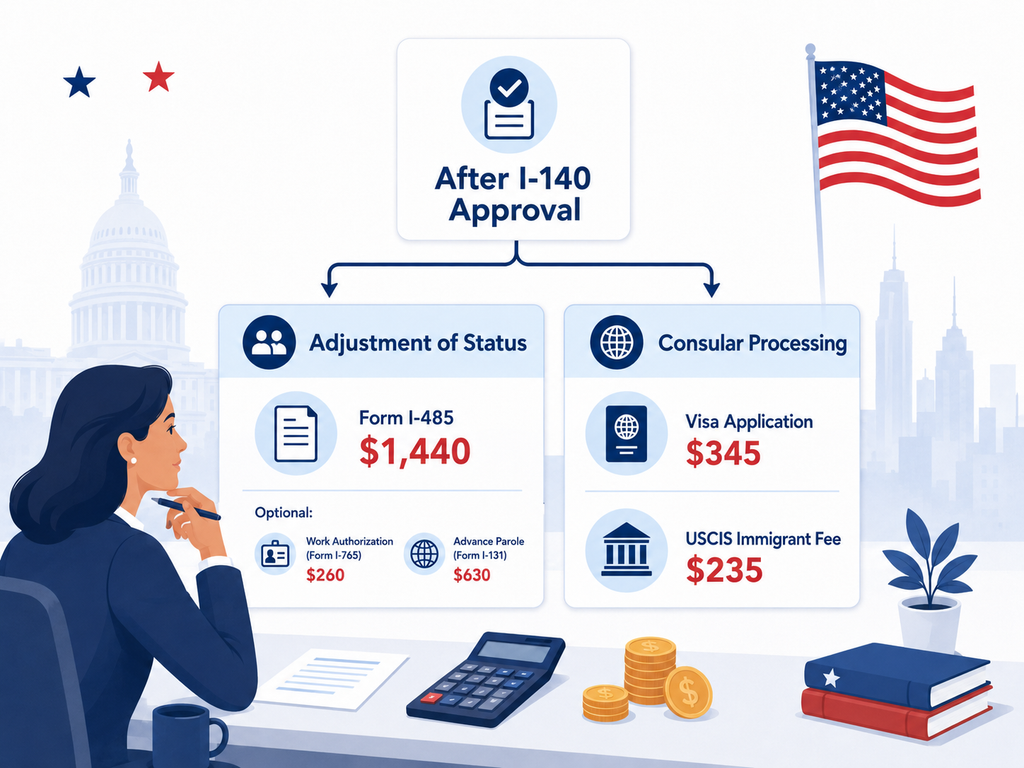
For adjustment of status, each applicant age 14 or older generally pays $1,440. A child under 14 filing concurrently with a parent’s I-485 generally pays $950.
| Example: married couple adjusting status | Cost |
|---|---|
| Principal’s I-140 + Asylum Program Fee | $1,015 |
| Principal I-485 | $1,440 |
| Spouse I-485 | $1,440 |
| Subtotal without premium | $3,895 |
| Subtotal with premium | $6,860 |
What if you use consular processing instead of I-485?
If you complete the immigrant-visa stage outside the United States, you do not pay the I-485 filing fee. The Department of State currently charges an employment-based immigrant visa application processing fee of $345 per person.
After immigrant visa issuance, a person immigrating as a lawful permanent resident generally pays the $235 USCIS Immigrant Fee, which supports production of the physical Green Card.
| Single applicant — consular route | Cost |
|---|---|
| I-140 + self-petitioner fee | $1,015 |
| Employment-based immigrant visa application | $345 |
| USCIS Immigrant Fee | $235 |
| Government subtotal without premium | $1,595 |
| Government subtotal with premium | $4,560 |
Medical examination, vaccinations, travel, police certificates, translations, and document procurement are separate.
Adjustment of status vs. consular processing: cost comparison
| Cost category | Adjustment of status | Consular processing |
|---|---|---|
| NIW petition stage | Same | Same |
| Final application | I-485: generally $1,440 age 14+ | IV application: $345 per person |
| USCIS Immigrant Fee | Not the normal I-485 fee | $235 per person |
| I-765 / I-131 | Optional separate fees | Not part of consular immigrant-visa processing |
| Medical | Variable | Variable |
| Travel | Usually domestic | Can be substantial depending on post |
Do not choose the route solely by the cheaper fee. Eligibility, lawful status, travel, employment, family circumstances, visa availability, and processing location can matter much more.
Private costs that are not included in USCIS fees
- Attorney or legal-review fees: private and highly variable.
- Credential evaluations: sometimes used for foreign degrees.
- Certified translations: required for non-English supporting documents.
- Expert opinion letters: optional in some cases, not a universal NIW requirement.
- Document procurement: transcripts, corporate records, certificates, and archives.
- Medical examination and vaccinations: provider-dependent.
- Printing, shipping, and courier services: especially for evidence-heavy filings.
- Travel: medical exams, interviews, biometrics, or consular appointments.
There is no official USCIS “average NIW attorney fee.” Treat universal private-fee numbers online as market estimates rather than government rules.
A better way to budget your NIW case
- Petition fees: I-140, Asylum Program Fee, optional premium processing.
- Evidence costs: translations, evaluations, expert evidence, document retrieval, legal help.
- Final Green Card costs: I-485 or immigrant-visa processing for every applicant.
- Contingency costs: RFE work, updated evidence, medicals, courier and travel.
EB-2 NIW budget worksheet
| Budget item | Known fee / status | Your budget |
|---|---|---|
| I-140 | $715 | _____ |
| Self-petitioner Asylum Program Fee | $300 | _____ |
| Premium processing | $0 or $2,965 | _____ |
| Credential evaluation | Variable | _____ |
| Translations | Variable | _____ |
| Attorney / legal review | Variable | _____ |
| Principal I-485 or IV fee | $1,440 or $345 | _____ |
| Derivative family | Route / age dependent | _____ |
| I-765 | $260 if applicable | _____ |
| I-131 | $630 paper / $580 online where eligible | _____ |
| USCIS Immigrant Fee | $235 per person if applicable | _____ |
| Medical / vaccinations | Variable | _____ |
| Shipping / travel / documents | Variable | _____ |
Can EB-2 NIW fees be refunded?
USCIS filing fees are generally non-refundable regardless of the decision or processing time. Premium processing has a separate service guarantee: if USCIS misses the applicable premium-processing period, it must refund the premium fee and continue expedited handling. A refund does not create an approval.
Can you pay all NIW fees together?
Do not assume every fee can be combined into one payment. USCIS instructions can require separate payments, and premium processing must be paid separately from other filing fees. Always follow the current form instructions and G-1055 rather than an old sample filing.
What happens if you pay the wrong fee?
An incorrect fee can cause USCIS to reject a filing before substantive adjudication. That can matter if timing affects a priority date, concurrent-filing opportunity, expiring status, or a planned premium-processing request.
- Check the current G-1055.
- Confirm the current form edition.
- Confirm all additional fees.
- Confirm separate-payment requirements.
- Confirm the current filing address.
- Recheck everything immediately before mailing or submitting.
Does premium processing save money?
Not directly. Premium processing adds $2,965. Its value is faster adjudicative action on the I-140. It may have indirect economic value when a faster decision affects employment, investment, relocation, or family planning, but it may offer little total-time benefit when your priority date is far from current.
Our EB-2 NIW processing time guide explains why petition speed and Green Card speed are different.
Can an RFE increase the total cost?
Yes. USCIS does not normally charge a separate filing fee just because it issues an RFE, but the response can generate new private costs: expert letters, translations, credential records, legal review, printing, and expedited delivery. Use our EB-2 NIW RFE guide to understand response strategy.
Five EB-2 NIW cost mistakes to avoid
- Budgeting only $715. A typical self-petitioner also owes the $300 Asylum Program Fee.
- Using the old $2,805 premium fee. The fee became $2,965 for qualifying requests postmarked on or after March 1, 2026.
- Assuming I-765 and I-131 are free with a new I-485. They now have separate fees.
- Forgetting derivative family members. Every spouse or child can add final-stage, medical and travel costs.
- Using a blog’s fee table without checking USCIS. The official fee schedule controls.
How cost fits into the larger NIW strategy
A cheap filing that is not ready can be more expensive than waiting and preparing a stronger case. Confirm the EB-2 NIW requirements, build evidence around the proposed endeavor and Dhanasar prongs, decide whether premium processing has practical value, then budget separately for the final Green Card stage.
If speed is your main concern, compare NIW with other paths in our fastest realistic Green Card options guide.
When do you actually pay each EB-2 NIW fee?
Not every fee is due on day one. Understanding the payment timeline matters because many applicants mistakenly add every possible cost together and assume they must pay the entire amount with Form I-140.
- At the NIW petition stage: the Form I-140 fee and applicable Asylum Program Fee are due with the petition.
- If you request premium processing: the Form I-907 fee is due when you file the premium request, either with the I-140 or later as an upgrade.
- If you adjust status: Form I-485 and any optional I-765 or I-131 fees are paid when those forms are filed, not automatically when the I-140 is filed.
- If you use consular processing: Department of State immigrant-visa fees are paid later in the NVC/consular process after petition approval and visa availability.
- After immigrant visa issuance: the USCIS Immigrant Fee is generally paid before or after entering the United States so USCIS can produce the physical Green Card.
This staged structure is useful for cash-flow planning. An applicant whose priority date is not current may pay only the I-140-stage costs now and face the larger family or final-stage costs much later.
Can USCIS fees change while your NIW case is pending?
Yes. Immigration fees can change through USCIS fee rules, statutory changes, or inflation adjustments. The premium-processing fee is a good example: it increased from $2,805 to $2,965 for qualifying requests postmarked on or after March 1, 2026.
The amount that matters is generally the fee required for the filing you are submitting at that time. If you filed an I-140 months ago and later decide to submit Form I-907, you must use the premium-processing fee in effect for the later I-907 request. Likewise, a future I-485 fee is determined by the rules in effect when you file that I-485, not necessarily the fee schedule that existed when the I-140 was submitted.
For that reason, a multi-year NIW budget should include a small contingency rather than assuming every later government fee will remain frozen.
Should you spend more on evidence or premium processing?
If your budget is limited, remember that premium processing does not repair a weak petition. The $2,965 fee accelerates USCIS action but does not change the legal standard under the National Interest Waiver framework.
A case with an unclear proposed endeavor, weak national-importance evidence, or poor documentation can simply receive a faster RFE. Before spending on speed, make sure the underlying petition is sufficiently developed. That can mean obtaining missing records, improving translations, documenting project impact, or getting qualified legal review where the case is complex.
The best allocation depends on the applicant. Someone with a very strong, complete case and a time-sensitive professional reason may value premium processing highly. Someone whose evidence still has obvious gaps may get more practical value from improving the record first.
Official sources
- USCIS — Form G-1055 Fee Schedule
- USCIS — Form I-140
- USCIS — Form I-907
- Federal Register — 2026 Premium Processing Inflation Adjustment
- USCIS — Form I-485
- USCIS — Form I-765
- USCIS — Form I-131
- Department of State — Visa Service Fees
- USCIS — Immigrant Fee
FAQ: EB-2 NIW Cost 2026
How much does an EB-2 NIW I-140 cost in 2026?
A typical self-petitioner pays $715 for Form I-140 plus a $300 Asylum Program Fee, for a basic I-140-stage government total of $1,015.
How much is EB-2 NIW premium processing in 2026?
For eligible premium-processing requests postmarked on or after March 1, 2026, the Form I-907 fee is $2,965.
What is the NIW filing total with premium processing?
For a typical self-petitioner, $715 plus $300 plus $2,965 equals $3,980 at the I-140 stage.
How much is Form I-485 in 2026?
The current USCIS fee schedule lists $1,440 for a general I-485 applicant age 14 or older and $950 for a qualifying child under 14 filing with a parent.
Are I-765 and I-131 free with I-485?
Not for newly filed I-485 cases under the current fee structure. They have separate filing fees when requested.
How much is consular processing after NIW approval?
The Department of State currently lists a $345 employment-based immigrant visa application fee per person, and a separate $235 USCIS Immigrant Fee generally applies after visa issuance.
Does each family member need a separate NIW I-140?
No. Derivative spouses and qualifying children do not each file a separate NIW I-140, but they generally have their own final-stage fees.
Are attorney fees included in USCIS filing fees?
No. Legal fees, translations, credential evaluations, expert evidence, medical exams, shipping and travel are separate private expenses.
Can USCIS refund a denied NIW filing fee?
USCIS filing fees are generally non-refundable. Premium processing has a separate service guarantee for refund of the premium fee if USCIS misses the applicable service period.
Can an RFE add another government filing fee?
USCIS does not normally charge a separate fee simply because it issues an RFE, but preparing a response may create additional private costs.