2025 U.S. Civics Test: 128 Questions, Passing Score and Who Takes It

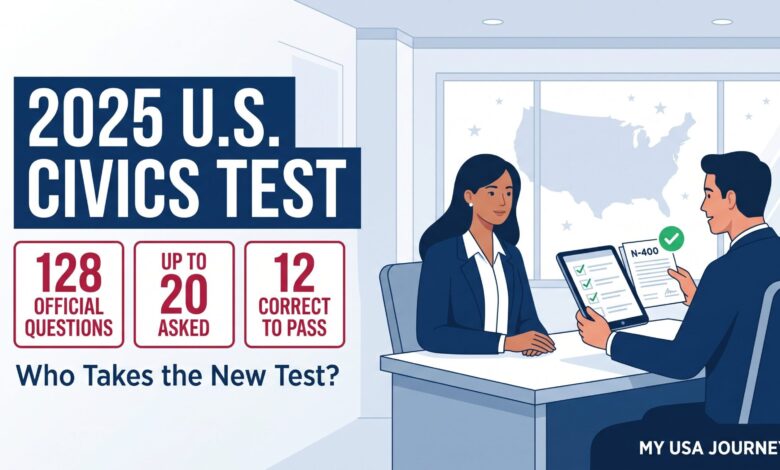
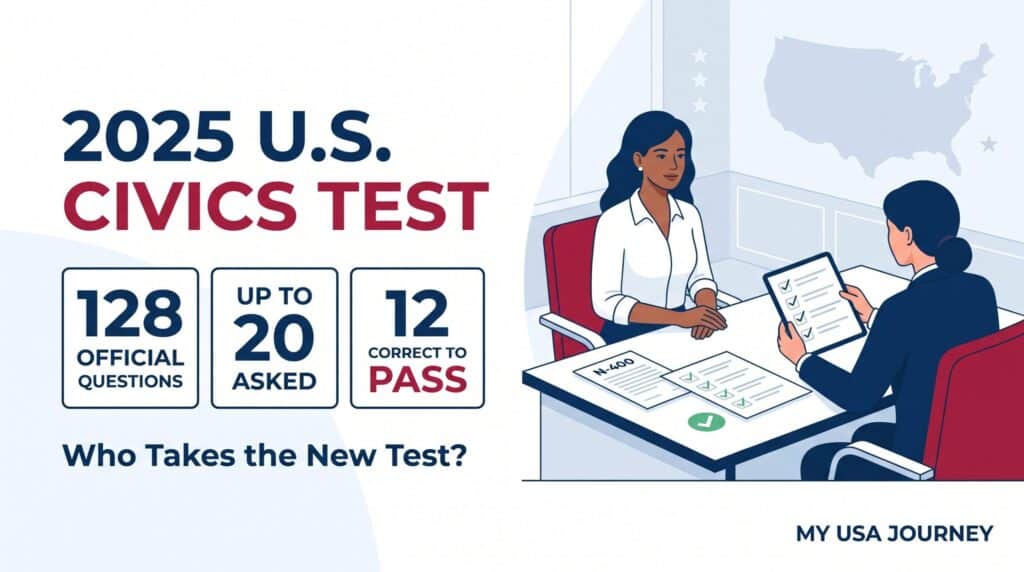
Last verified: July 27, 2026. The 2025 U.S. naturalization civics test uses a bank of 128 questions. For most applicants, a USCIS officer asks up to 20 questions orally, and the applicant must answer 12 correctly to pass. The officer stops once the applicant reaches 12 correct answers or 9 incorrect answers.
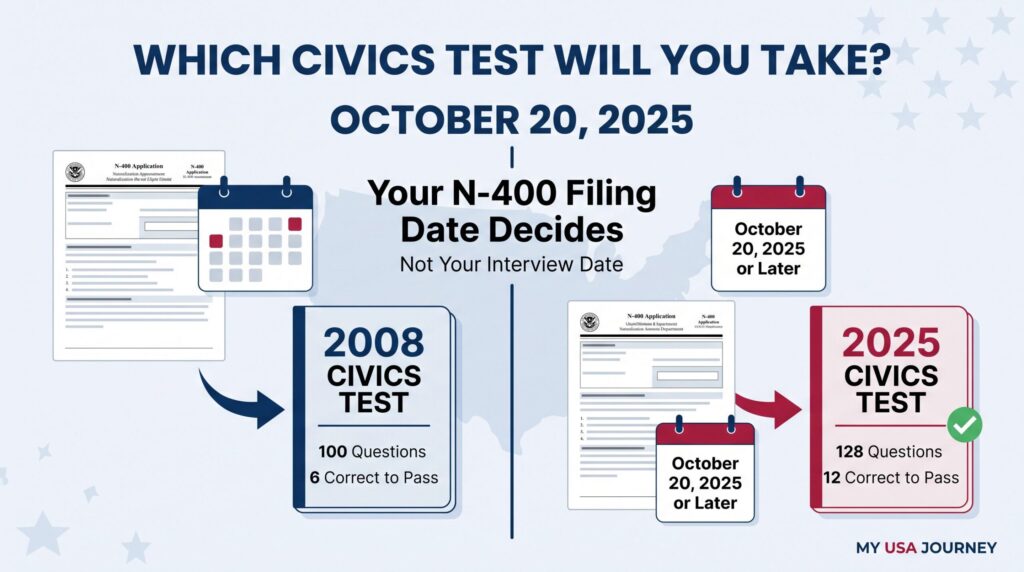
The name can be confusing in 2026: USCIS still calls it the 2025 Naturalization Civics Test. Whether you take this version or the older 2008 test depends primarily on the date USCIS received your Form N-400, not the date of your interview.
This guide provides general educational information, not legal advice. Always use the current USCIS study materials and follow the instructions on your appointment notice.
2025 civics test rules at a glance
| Rule | Most applicants taking the 2025 test | Qualified 65/20 applicants |
|---|---|---|
| Question bank | 128 official questions | 20 specially marked questions |
| Questions asked | Up to 20 | Up to 10 |
| Correct answers needed | 12 | 6 |
| How the test is given | Orally, not multiple choice | Orally, in the applicant’s chosen language with an interpreter |
| When questioning stops | After 12 correct or 9 incorrect answers | After 6 correct or 5 incorrect answers |
These figures apply to the civics portion only. Unless an exception or disability waiver applies, naturalization applicants also complete an English test and answer questions about their Form N-400 during the interview.
Who takes the 2025 U.S. civics test?
USCIS administers the 2025 civics test to applicants whose Form N-400 was filed on or after October 20, 2025. Applicants who filed before that date generally take the 2008 civics test, even if their interview occurs in 2026.
Use the receipt date shown on your Form I-797 receipt notice or in your USCIS online account. Do not choose a study guide based only on the year printed on your interview notice. If you are unsure which test applies, compare your N-400 filing date with the official USCIS test update page.
- N-400 filed before October 20, 2025: study the 2008 test.
- N-400 filed on October 20, 2025: study the 2025 test.
- N-400 filed after October 20, 2025: study the 2025 test.
This filing-date rule prevents a common and costly mistake: memorizing the wrong question bank. The old test has 100 study questions, while the new test has 128 and a different interview format.
2025 test vs. 2008 test
| Feature | 2008 civics test | 2025 civics test |
|---|---|---|
| Who generally takes it | N-400 filed before October 20, 2025 | N-400 filed on or after October 20, 2025 |
| Official question bank | 100 questions | 128 questions |
| Questions asked | Up to 10 | Up to 20 |
| Correct answers required | 6 | 12 |
| Passing percentage | 60% | 60% |
| Format | Oral | Oral |
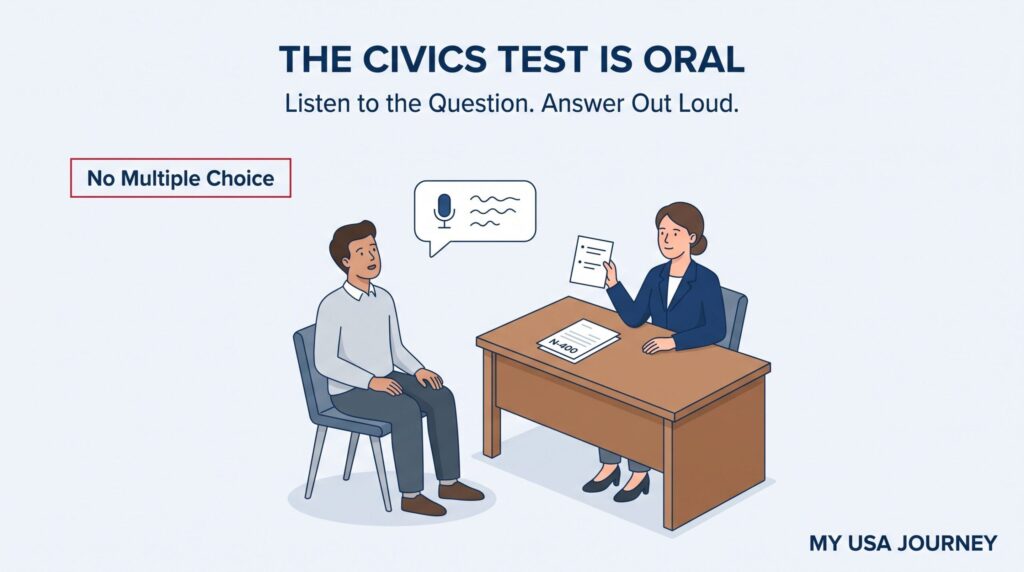
The 2025 test is longer, but the passing percentage remains 60%. It is not a written multiple-choice exam. The officer asks each question aloud, and you respond aloud. You do not receive four possible answers to choose from.
If your filing date places you under the older version, use the official USCIS 2008 civics test materials. Studying all 128 new questions does not replace preparation for the version USCIS will actually administer.
What is in the 128-question bank?
The official bank tests knowledge of American government, history, geography, symbols, and civic principles. The questions include the Constitution, branches of government, rights and responsibilities, important historical events, national symbols, and elected officials.
USCIS publishes the complete 128 Questions and Answers PDF. That official document should be your master list. Third-party quizzes can help with repetition, but they should not replace the USCIS wording and accepted answers.
Some answers can change
Several answers depend on current officeholders or where you live. Examples include the President, Vice President, Speaker of the House, your state’s governor, and one of your state’s U.S. senators. These answers may change after elections, resignations, appointments, or succession.
USCIS expects the correct answer at the time of your interview. Check the official test updates shortly before your appointment. For state-specific questions, confirm your current state and congressional district rather than memorizing an answer from someone else’s flash cards.
How the civics test works during the interview
The civics test is one part of the naturalization interview. A USCIS officer also reviews your identity, immigration history, travel, residence, employment, family information, taxes, and the answers on your Form N-400. The speaking portion of the English test is evaluated during that conversation unless you qualify for an exception.
- The officer places you under oath and verifies your identity.
- The officer reviews your N-400 and asks eligibility questions.
- The officer administers the English tests if they apply to you.
- The officer asks civics questions orally from the correct official bank.
- The officer records whether you passed each required portion.
You do not necessarily hear all 20 civics questions. For the standard 2025 test, the officer stops once you answer 12 correctly. The officer also stops if you reach 9 incorrect answers, because it is then impossible to earn 12 correct answers within 20 questions.
Answer the question asked. A short accepted answer is usually better than a long speech that introduces uncertainty. If a question asks for one example, provide one clear accepted example. If you do not hear the question, politely ask the officer to repeat it rather than guessing.
What score do you need to pass?
Most applicants taking the 2025 civics test must answer 12 of up to 20 questions correctly. That is a 60% passing standard. However, treating 60% as your study target leaves little room for nerves, misunderstanding, or a changing answer.
A safer preparation goal is consistent performance well above the minimum across the entire question bank. Practice in random order, answer aloud, and include questions you find difficult. Repeating only a familiar set can create a false sense of readiness because the officer selects questions from the official bank.
The 65/20 special consideration
An applicant may receive special consideration if, at the time of filing Form N-400, the applicant is at least 65 years old and has lived in the United States as a lawful permanent resident for at least 20 years. USCIS commonly calls this the 65/20 rule.
A qualifying 65/20 applicant studies only the 20 questions marked with an asterisk in the official 2025 question bank. The officer asks up to 10 of those specially selected questions, and the applicant must answer 6 correctly. Questioning stops after 6 correct answers or 5 incorrect answers.
The applicant may take the civics test in the language of choice but must bring an interpreter who is fluent in both English and that language. The interpreter should be prepared to present identification and translate accurately without answering for the applicant.
50/20 and 55/15 English exceptions
The 50/20 and 55/15 rules are often misunderstood as complete exemptions from testing. They are primarily exceptions to the English requirement:
- 50/20: age 50 or older with at least 20 years as a lawful permanent resident at the time of filing.
- 55/15: age 55 or older with at least 15 years as a lawful permanent resident at the time of filing.
Applicants who qualify do not have to demonstrate English speaking, reading, and writing, but they still take the civics test. They may take civics in their language of choice and must generally bring a qualified interpreter. Unless they also qualify for 65/20 special consideration, they study the regular question bank and follow the regular civics scoring rules for their test version.
USCIS calculates the age and permanent-resident periods under specific rules. Review the current USCIS exceptions and accommodations page before assuming that you qualify.
Medical disability exception and accommodations
A qualifying physical or developmental disability or mental impairment may support an exception to the English requirement, the civics requirement, or both through Form N-648. This is different from the age-and-residence rules.
Age, limited education, difficulty reading, or difficulty learning English does not by itself establish eligibility for Form N-648. An authorized medical professional must complete the form and explain how a medically determinable impairment prevents the applicant from meeting the testing requirement.
Reasonable accommodations can also help an applicant participate in the interview without waiving the test. Examples may include sign-language interpretation, extra time, large-print materials, or an accessible interview location. Request accommodations through the process described by USCIS and include enough information for the agency to prepare.
Do you also have to pass an English test?
Usually yes. The civics test and English test are separate requirements. Unless an exception applies, the English portion includes:
- Speaking: evaluated through your answers during the N-400 eligibility interview.
- Reading: you must read one of up to three sentences correctly.
- Writing: you must write one of up to three sentences correctly.
Passing civics does not compensate for failing a required English portion, and passing English does not compensate for failing civics. USCIS records the result of each portion separately.
What happens if you fail the civics test?
An applicant normally has two opportunities to meet the English and civics requirements for one naturalization application. If you fail a portion at the first examination, USCIS generally schedules a second examination between 60 and 90 days later.
USCIS retests only the portion you failed. For example, if you passed reading, writing, and speaking but failed civics, the second examination generally covers civics rather than restarting every test. Follow the new appointment notice because the exact date and location come from USCIS.
If you fail the required portion again, USCIS may deny the N-400. A later application generally requires a new filing and fee, subject to the rules then in effect. This is why the second opportunity should be treated as a formal reexamination, not an informal practice session.
A practical study plan for 128 questions
Trying to memorize 128 answers in one sitting is inefficient. A structured plan makes the material easier to recall under interview pressure.
1. Start with the official question bank
Download the current USCIS PDF and use it as your source of truth. Mark questions with more than one accepted answer, questions that require your state or district, and answers that can change after an election or appointment.
2. Study by topic, then randomize
Begin with small groups such as principles of government, branches of government, rights and responsibilities, colonial history, modern history, geography, and national symbols. Once you can answer by topic, switch to mixed random practice so you do not depend on a predictable order.
3. Practice aloud without answer choices
Reading an answer silently or recognizing it in a multiple-choice quiz is easier than producing it aloud. Ask another person to read the exact question, or use audio practice, and respond without looking at options.
4. Track weak questions
Create a short review list from questions you miss or answer slowly. Review that list more often, but continue testing the full bank. Remove a question from the weak list only after answering it correctly several times on different days.
5. Simulate the stopping rule
Run practice interviews with up to 20 random questions. Stop at 12 correct or 9 incorrect answers and record the result. This mirrors the structure of the standard 2025 test more closely than completing all 128 questions every day.
6. Recheck changing answers before the interview
Review current officeholders and location-specific answers during the final week and again shortly before the appointment. A flash card created months earlier may no longer be accurate.
A 14-day review schedule
If your interview is approaching and you already know some of the material, this two-week structure can organize your final review. It is a review plan, not a guarantee that fourteen days will be enough for every learner.
| Days | Focus | Practice goal |
|---|---|---|
| 1-2 | Principles of American government and the Constitution | Learn the accepted short answers and explain the main ideas in your own words. |
| 3-4 | Branches of government and elected officials | Separate federal, state, and local roles; verify changing names. |
| 5-6 | Rights, responsibilities, and civic participation | Practice questions with several accepted examples. |
| 7-8 | Colonial period, independence, and the Constitution | Build a simple timeline instead of memorizing isolated facts. |
| 9-10 | 1800s, recent history, geography, and symbols | Review dates, conflicts, places, and national observances. |
| 11-12 | Weak questions and changing answers | Repeat missed questions aloud and confirm current officeholders. |
| 13 | Full random simulations | Complete several sessions using the 12-correct or 9-incorrect stopping rule. |
| 14 | Light review and interview preparation | Review the weak list, organize documents, and avoid exhausting last-minute study. |
Adjust the pace to your starting level. Someone learning the material for the first time may need several weeks or months. A learner who qualifies for 65/20 special consideration should build the schedule around the 20 specially marked questions and the 6-of-10 format.
How USCIS evaluates an oral answer
The official question list often provides more than one acceptable response. You normally need to give the number of answers requested, not every answer printed in the guide. For a question that asks for one right, one correct right is enough. For a question that asks for two examples, provide two.
Exact word-for-word recitation is not always necessary when your response clearly communicates an accepted answer, but changing the meaning can make an answer incorrect. Use the concise wording in the USCIS guide during practice. This reduces the risk of adding an incorrect detail to an otherwise correct response.
An accent does not automatically make an answer wrong. The officer must be able to understand the response. Practice at a steady volume and pace, and ask for a question to be repeated when necessary. Do not expect the officer to explain a question, translate it, or turn it into multiple choice unless a recognized language exception or accommodation applies.
Common preparation mistakes
- Studying the wrong version: use the N-400 filing date, not the interview year.
- Using only multiple-choice apps: the real civics test is oral.
- Memorizing outdated names: verify changing answers with USCIS.
- Ignoring the N-400 review: the interview is broader than civics questions.
- Confusing 50/20 with a civics waiver: qualifying applicants still take civics.
- Assuming 65/20 removes every test: it changes the bank and scoring but still includes civics.
- Studying only the easiest questions: the officer can select from the full applicable bank.
- Waiting until the appointment notice: regular short sessions are more effective than last-minute memorization.
What to bring to the naturalization interview
Your appointment notice and individual case determine the complete document list. At a minimum, applicants commonly bring the interview notice, Permanent Resident Card, state-issued identification, and all current and expired passports or travel documents covering the relevant period.
Bring original or certified records required by your case, including documents related to marriage, divorce, name changes, taxes, Selective Service, arrests, citations, court matters, child support, or extended travel when applicable. If information changed after filing, be ready to explain the update truthfully.
The civics test does not replace the eligibility review. Before attending, read our complete Form N-400 and naturalization guide for the residence, physical-presence, good-moral-character, filing, interview, and oath stages.
Official USCIS study resources
- 2025 Civics Test overview
- 128 Civics Questions and Answers PDF
- Current answers and test updates
- English exceptions, 65/20, Form N-648, and accommodations
- Naturalization interview and test
Study materials are most useful when they match your test version and remain current. Save the USCIS links, but check them again before the interview in case the agency updates an answer, file, or instruction.
2025 U.S. civics test FAQ
How many questions are on the 2025 U.S. civics test?
The official study bank contains 128 questions. A USCIS officer asks most applicants up to 20 questions orally during the naturalization interview.
How many correct answers do I need to pass?
Most applicants must answer 12 questions correctly. The officer stops after 12 correct answers or 9 incorrect answers.
Who takes the 2025 civics test?
USCIS generally gives the 2025 test to applicants whose Form N-400 was filed on or after October 20, 2025.
Which test applies if my interview is in 2026?
Your interview year does not decide the version. If USCIS received your N-400 before October 20, 2025, you generally take the 2008 test. If it was filed on or after that date, you take the 2025 test.
Is the 2025 civics test multiple choice?
No. It is an oral test. The USCIS officer asks questions aloud, and you answer aloud without receiving a list of possible answers.
What is the 65/20 rule?
An applicant who is at least 65 and has been a lawful permanent resident for at least 20 years at filing may study 20 specially marked questions. The officer asks up to 10, and 6 correct answers are required.
Can I take the civics test in my own language?
Applicants who qualify for the 50/20, 55/15, or 65/20 rules may take civics in their language of choice but generally must bring a qualified interpreter. Other applicants normally take the test in English unless a disability exception applies.
Do 50/20 applicants still take the civics test?
Yes. The 50/20 rule is an exception to the English requirement, not a complete civics waiver. A qualifying applicant still takes civics in the chosen language.
Do civics answers ever change?
Yes. Answers involving elected or appointed officials and some location-specific questions can change. USCIS expects the correct answer at the time of the interview.
What happens if I fail civics at the first interview?
USCIS generally gives a second opportunity 60 to 90 days later and retests only the portion that was failed.
Does passing civics mean I passed the entire naturalization test?
Not necessarily. Unless an exception applies, you must also satisfy the English speaking, reading, and writing requirements and complete the N-400 eligibility review.
Where can I download all 128 official questions?
USCIS publishes the official 128 Questions and Answers PDF on its 2025 civics test page. Use that file and check the USCIS updates page before your interview.
Final checklist
- Confirm the date USCIS received your Form N-400.
- Study the correct official question bank.
- Practice orally without multiple-choice prompts.
- Review changing and state-specific answers before the interview.
- Confirm whether an English exception, 65/20 consideration, accommodation, or Form N-648 applies.
- Prepare for the English test and N-400 review as well as civics.
The 2025 civics test is manageable when you study the correct version, use official materials, and practice the format USCIS actually uses. Build accuracy across the full applicable bank rather than aiming only for the minimum passing score.