Naturalization Documents Checklist: What to Bring to Your N-400 Interview

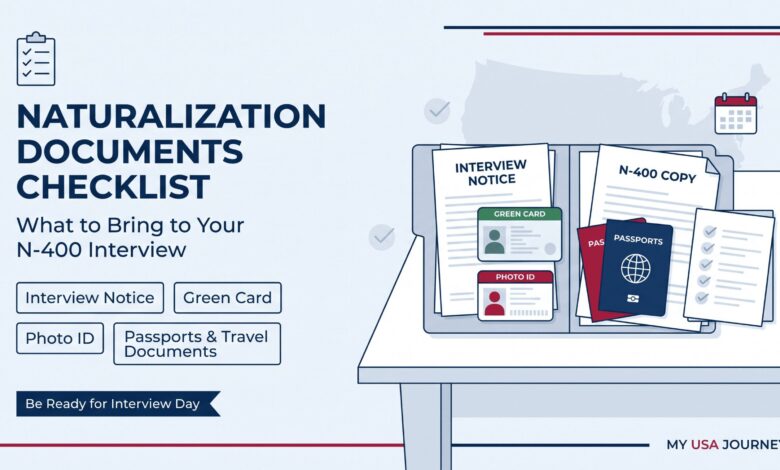
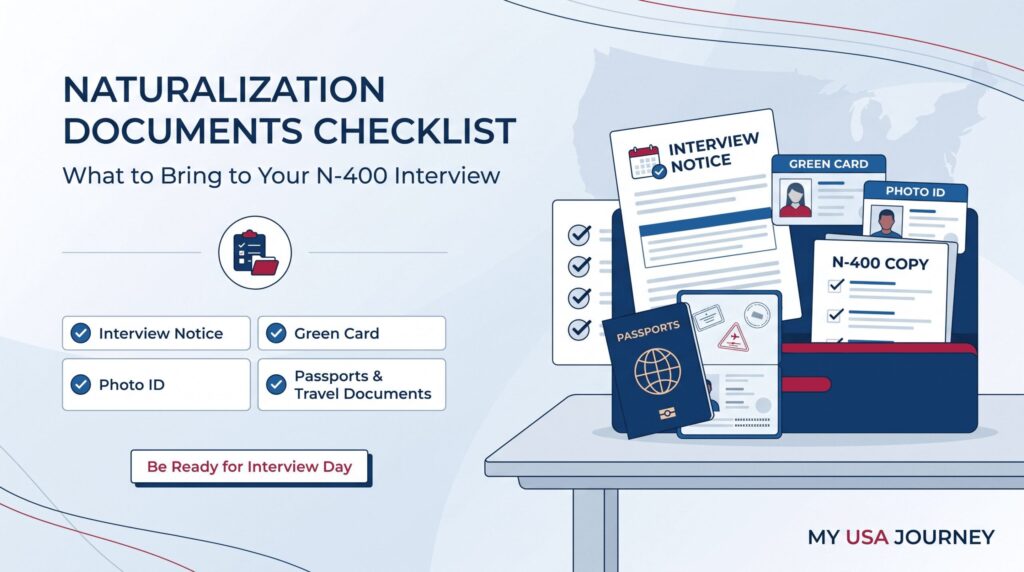
Last verified: July 27, 2026. The safest way to prepare for a naturalization interview is to separate documents into two groups: items every applicant should bring and evidence that applies only to a particular history or eligibility category. USCIS identifies four core items for the interview: the appointment notice, Permanent Resident Card, a state-issued photo ID, and all valid and expired passports and travel documents that record absences since becoming a permanent resident.
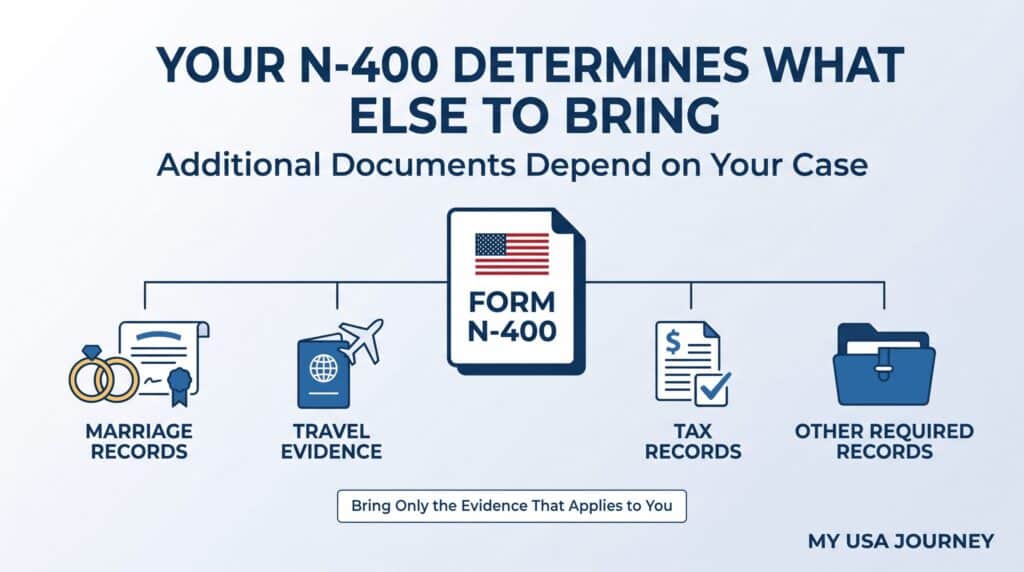
That short list is only the starting point. Your Form N-400 answers determine whether you should also carry marriage records, tax transcripts, Selective Service evidence, court dispositions, child-support records, proof of residence with a U.S. citizen spouse, or documents explaining a trip, name change, or correction. Bringing an organized file can help the officer verify the case without issuing a request for additional evidence, but carrying irrelevant papers does not cure an eligibility problem.
Quick N-400 interview document checklist
- Interview appointment notice: the original USCIS notice showing the field office, date, and time.
- Permanent Resident Card: your Form I-551, commonly called a Green Card, even if it is expired or you have replacement or extension evidence.
- State-issued photo identification: such as a driver’s license or state ID.
- Passports and travel documents: every valid and expired document issued to you that records travel outside the United States since you became a permanent resident.
- A complete copy of the N-400: including the evidence submitted and a written list of changes since filing.
- Situation-specific originals or certified records: only where your eligibility, history, or the interview notice requires them.
Read the appointment notice carefully before relying on any online checklist. A notice may ask for an item that is not listed here because USCIS has already identified a question in your file. The notice and any later USCIS request control your appointment preparation.
Documents every naturalization applicant should bring
| Document | Why USCIS needs it | Preparation tip |
|---|---|---|
| Interview notice | Confirms the appointment and case | Bring the original and arrive at the location printed on it |
| Green Card | Confirms lawful permanent resident identity | Bring the card plus extension or replacement evidence if applicable |
| State photo ID | Provides a second identity check | Use a current driver’s license or state identification card |
| Passports and travel documents | Helps verify absences and travel history | Include valid and expired documents covering the permanent-resident period |
| N-400 copy | Helps you follow the officer’s review | Mark corrections and post-filing changes without altering the submitted copy |
If your Green Card has expired, do not assume you should leave it at home. Bring it together with any Form I-797 extension notice, temporary proof of status, Form I-90 receipt, or other document USCIS issued for the replacement or extension. If the card was lost or stolen, bring the available police report, replacement filing receipt, or temporary evidence rather than trying to hide the issue.
Bring a complete copy of your filed N-400
USCIS will review the application under oath. Your personal preparation set should therefore include the exact N-400 submitted, all continuation pages, translations, uploaded evidence, and any response sent after filing. If you filed online, download or print the filed application and case documents from your USCIS account before the interview.
Read each answer rather than memorizing a script. Prepare a separate update sheet listing every change after filing: new trips, a new address, employment changes, marriage or divorce, a child’s birth, a citation or arrest, unpaid taxes, organization membership, or any correction to an inaccurate answer. Tell the officer about relevant changes before confirming the application as correct.
Passports, travel records, and proof of U.S. residence
Travel documents are central because naturalization usually requires both continuous residence and physical presence. Bring every passport and reentry permit issued during the relevant permanent-resident period, including expired and canceled passports. Do not bring only the newest passport if an older one contains stamps covering trips listed on the N-400.
If a passport is unavailable, collect other reliable records that help reconstruct travel: airline itineraries, entry records, employment attendance, leases, mortgage statements, school records, medical records, bank activity, or IRS transcripts. These papers become especially important when a single absence lasted more than six months, when several trips created a close physical-presence calculation, or when passport stamps do not match the dates on the application.
For a detailed explanation of the different residence tests, read Continuous Residence vs. Physical Presence for Naturalization. A document checklist cannot determine whether a long absence broke continuous residence; it can only help you prove the facts USCIS must evaluate.
Documents for applicants using the three-year marriage rule
An applicant filing under the three-year rule based on marriage to a U.S. citizen must prove more than the existence of a marriage certificate. USCIS generally examines whether the spouse has been a U.S. citizen for the required period and whether the couple lived in marital union during the statutory period.
- Your current marriage certificate.
- Proof of the spouse’s U.S. citizenship, such as a birth certificate, naturalization certificate, citizenship certificate, or valid U.S. passport.
- Evidence of living together, such as joint leases or mortgages, joint tax returns or transcripts, insurance, bank records, children’s birth certificates, and other shared household records.
- Certified termination records for every prior marriage of either spouse, including divorce decrees, annulments, or death certificates.
- Evidence explaining any separation, different addresses, or significant period living apart.
Choose documents that cover the entire relevant period rather than presenting a large stack from only the month before the interview. A pending divorce, legal separation, or end of marital union can affect eligibility under the three-year rule. That issue requires legal analysis, not simply more joint bills.
Tax documents to take to the citizenship interview
Tax compliance is relevant to good moral character and to several N-400 questions. Bring IRS tax transcripts or certified returns for the relevant period when the application, interview notice, filing category, or personal history makes them useful. Transcripts are usually easier for USCIS to verify than unsigned copies printed from tax software.
- If you filed every required return, bring transcripts covering the statutory period when requested or when the record needs confirmation.
- If you owed taxes, bring the IRS or state payment agreement and evidence that payments are current.
- If you did not file because you were not required to, bring evidence supporting that conclusion rather than relying on a verbal statement.
- If you claimed nonresident status after becoming a permanent resident, obtain individualized immigration and tax advice before the interview.
Do not create or amend a tax filing solely to make the naturalization file look better without understanding its accuracy. Resolve tax inconsistencies with a qualified professional and be prepared to explain the truthful history.
Selective Service records
The N-400 asks about Selective Service registration. Applicants whose history falls within the registration rules may need proof of registration. A registration acknowledgment or online verification can resolve a straightforward record. If you did not register, USCIS may examine your age, immigration status, dates in the United States, and whether the failure was knowing and willful.
Bring a Status Information Letter when appropriate, together with documents establishing the timeline and a truthful written explanation. The legal effect depends on the applicant’s age at filing and the facts of the failure. A letter does not automatically excuse nonregistration, but it can document whether Selective Service had a registration record and what information it considered.
Arrests, citations, charges, and court records
Applicants should not assume that an expunged, dismissed, sealed, juvenile, foreign, or old case can be omitted. The N-400 uses broad questions, and USCIS may require certified records even when a criminal court no longer treats the matter as a conviction. Bring certified arrest reports, charging documents, court dispositions, sentencing records, probation completion evidence, and proof of payment when they exist and apply.
If a court or police agency states that no record is available, obtain a certified letter confirming unavailability and preserve any other reliable document. Traffic tickets without an arrest may be treated differently from alcohol-related driving, reckless driving, suspended-license, injury, or criminal traffic cases. When the answer could affect eligibility or removability, consult an experienced immigration attorney before attending the interview.
Child support, alimony, and dependent children
The officer may review whether an applicant supports dependents and complies with court-ordered obligations. If the N-400 raises this issue, bring children’s birth certificates, custody orders, support orders, payment histories, bank records, wage withholding statements, and evidence of an agreed arrangement. For overdue support, carry proof of the current repayment plan and recent compliance.
A receipt from one recent payment may not explain years of missing payments. Organize the evidence chronologically and be ready to explain periods of unemployment, disputes, informal payments, or changes in custody without blaming the other parent or minimizing a court order.
Name changes, marriages, divorces, and family records
Bring civil records that connect every name used in the immigration file. Depending on the case, this may include birth certificates, marriage certificates, divorce decrees, adoption decrees, or court-ordered name changes. Originals or certified copies are safer where USCIS must verify an official event.
If you request a legal name change through naturalization, confirm whether the oath ceremony in your jurisdiction can accommodate judicial name changes. An officer can update biographical information, but the mechanism and timing for a legal name change may depend on the ceremony process.
Translations and foreign-language documents
A foreign-language document should be accompanied by a complete English translation and the translator’s certification that the translation is accurate and that the translator is competent to translate. Do not submit a summary that omits stamps, annotations, or back pages. Carry the original foreign-language record together with the translation when USCIS may need to compare them.
The translator generally does not need to be a commercial company, but the certification must be credible and complete. The applicant should not improvise a translation at the interview for a material civil or court record.
Documents for disability accommodations or an N-648 waiver
If you requested a disability accommodation, review the appointment arrangements and bring relevant USCIS correspondence. If you submitted Form N-648 for a medical disability exception to the English and civics requirements, bring a copy of the filed form and any updated medical documentation requested by USCIS.
Form N-648 is not a general exemption for age, limited schooling, nervousness, or difficulty learning English. It must be completed by an authorized medical professional and explain the medically determinable impairment and its connection to the inability to meet the testing requirements. Do not ask a family member to answer eligibility questions unless an approved process or accommodation permits it.
Military and other special naturalization cases
Military applicants and people applying under special statutory provisions may need service records, discharge documents, certified Form N-426 information, deployment evidence, or documents establishing the specific eligibility route. Use the checklist attached to that process and the interview notice rather than assuming the civilian five-year checklist is complete.
Likewise, applicants preserving residence through Form N-470, spouses of U.S. citizens employed abroad, and applicants with prior removal proceedings should bring the approval notices and records tied to that exception or history.
What not to bring to a USCIS field office
Follow the security instructions on the appointment notice and the field office page. Weapons and prohibited items are not allowed. Avoid carrying oversized bags, unrequested electronic equipment, sealed envelopes you cannot identify, or original documents unrelated to the case. Keep essential records in a compact, searchable file.
Do not bring fraudulent letters, recreated receipts, altered travel records, or a rehearsed explanation that contradicts the facts. An organized honest file is more valuable than a thick file assembled to create an appearance.
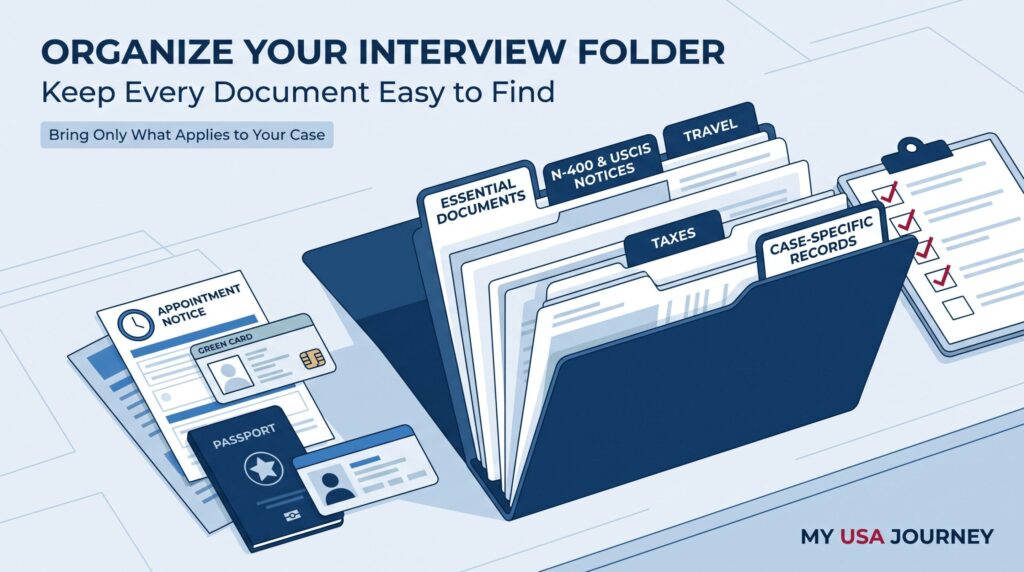
How to organize your interview folder
- Place the appointment notice, Green Card, photo ID, and passports in the first section.
- Add the filed N-400, receipt notice, biometrics notice, and copies of every USCIS submission.
- Create a one-page timeline of addresses, employment, marriages, children, and trips.
- Use labeled dividers for taxes, marriage, travel, Selective Service, court records, and other applicable issues.
- Keep originals or certified copies next to the corresponding photocopies and translations.
- Write a short list of corrections and changes since filing so nothing is forgotten under stress.
Do not hand the officer the entire folder unless asked. Listen to the question, provide the requested document, and keep the rest organized. This allows the interview to move efficiently and reduces the risk of presenting a confusing or inconsistent record.
Originals, certified copies, or photocopies?
Bring originals or certified copies of civil and court records when USCIS may need to inspect authenticity, along with ordinary copies that can be retained if requested. A plain internet printout is not the same as a certified court disposition. Never surrender an irreplaceable original without confirming whether USCIS needs to retain it and obtaining appropriate documentation of the submission.
For routine supporting evidence such as joint bills or bank statements, clear copies may be sufficient unless the notice requests originals. The document’s purpose matters: identity, immigration status, and official case outcomes generally require stronger proof than ordinary shared-address evidence.
What if you forgot a document?
Attend the appointment unless USCIS instructs otherwise. Explain the missing item honestly. The officer may be able to decide the case using the existing record, ask you to upload or mail a document, continue the examination, or issue Form N-14 requesting specific evidence. Missing a document does not always mean denial, but failing to respond by the stated deadline can.
Do not guess about a date or sign a correction you do not understand merely to finish the interview. Ask the officer to repeat or clarify the request. If the missing evidence concerns a potentially disqualifying issue, seek legal advice promptly before sending an explanation.
When to speak with an immigration lawyer before the interview
A routine document checklist is not enough when the file includes an arrest or conviction, a false claim to U.S. citizenship, unlawful voting, removal history, suspected fraud, long absences, nonresident tax filings, failure to support dependents, Selective Service problems, inconsistent marriage evidence, or a material fact omitted from the N-400. These issues can affect naturalization and, in some cases, the applicant’s underlying immigration status.
For a broader explanation of the appointment itself, use our U.S. Citizenship Interview Questions guide. For the civics portion, review the 2025 U.S. Civics Test guide. The filing date of the N-400 determines which civics test applies.
Frequently asked questions
What documents are required for every N-400 interview?
USCIS tells applicants to bring the interview appointment notice, Permanent Resident Card, a state-issued photo ID, and all valid and expired passports and travel documents that record absences since becoming a permanent resident.
Should I bring a copy of my N-400 to the interview?
Yes. Bring the complete filed application, continuation pages, evidence, and a list of corrections or changes since filing. This helps you follow the officer’s review accurately.
Do I need to bring tax returns to my citizenship interview?
Tax records are not equally necessary in every case, but USCIS may request transcripts or returns and they are important when filing under the three-year marriage rule, when taxes are owed, or when the N-400 raises a tax issue.
How many years of tax transcripts should I bring?
The relevant period depends on the eligibility basis and the issue being documented. Applicants often prepare records for the five-year statutory period, or three years when applying under the marriage rule, but the interview notice and case facts control.
Do I need every old passport for naturalization?
Bring all valid and expired passports and travel documents issued to you that document absences from the United States since you became a permanent resident.
What if I lost an old passport?
Bring any available police report or loss evidence and use other reliable records to reconstruct travel, such as itineraries, entry records, employment records, leases, school records, or bank activity.
Should marriage-based applicants bring joint documents?
Applicants using the three-year rule should be ready to prove the spouse’s U.S. citizenship and marital union during the required period with appropriate civil and shared-life records.
Do expunged or dismissed arrests require court records?
They may. The N-400 asks broad questions, and USCIS can require certified records even when a charge was dismissed, sealed, expunged, old, or handled outside the United States.
Can I use photocopies at the naturalization interview?
Bring originals or certified copies where USCIS must verify official civil, identity, immigration, or court records, plus photocopies when useful. Ordinary supporting evidence may be accepted as clear copies unless USCIS requests originals.
Do foreign-language records need translations?
Yes. Provide a complete English translation with a certification that the translation is accurate and that the translator is competent, and bring the underlying foreign-language document when appropriate.
What happens if I forget a document at the interview?
Attend unless USCIS instructs otherwise and explain the omission. The officer may request the document later, continue the examination, or issue Form N-14. Respond by every stated deadline.
Can USCIS ask for documents not listed on the standard checklist?
Yes. The appointment notice, case history, and officer’s review may require additional evidence tailored to the applicant. Always follow the specific USCIS notice over a general online checklist.
Official sources
- USCIS: Citizenship, What to Expect
- USCIS Form M-477: Document Checklist
- USCIS: Form N-400, Application for Naturalization
- USCIS Policy Manual: Naturalization Interview